.svg)
What is the Canton Network?
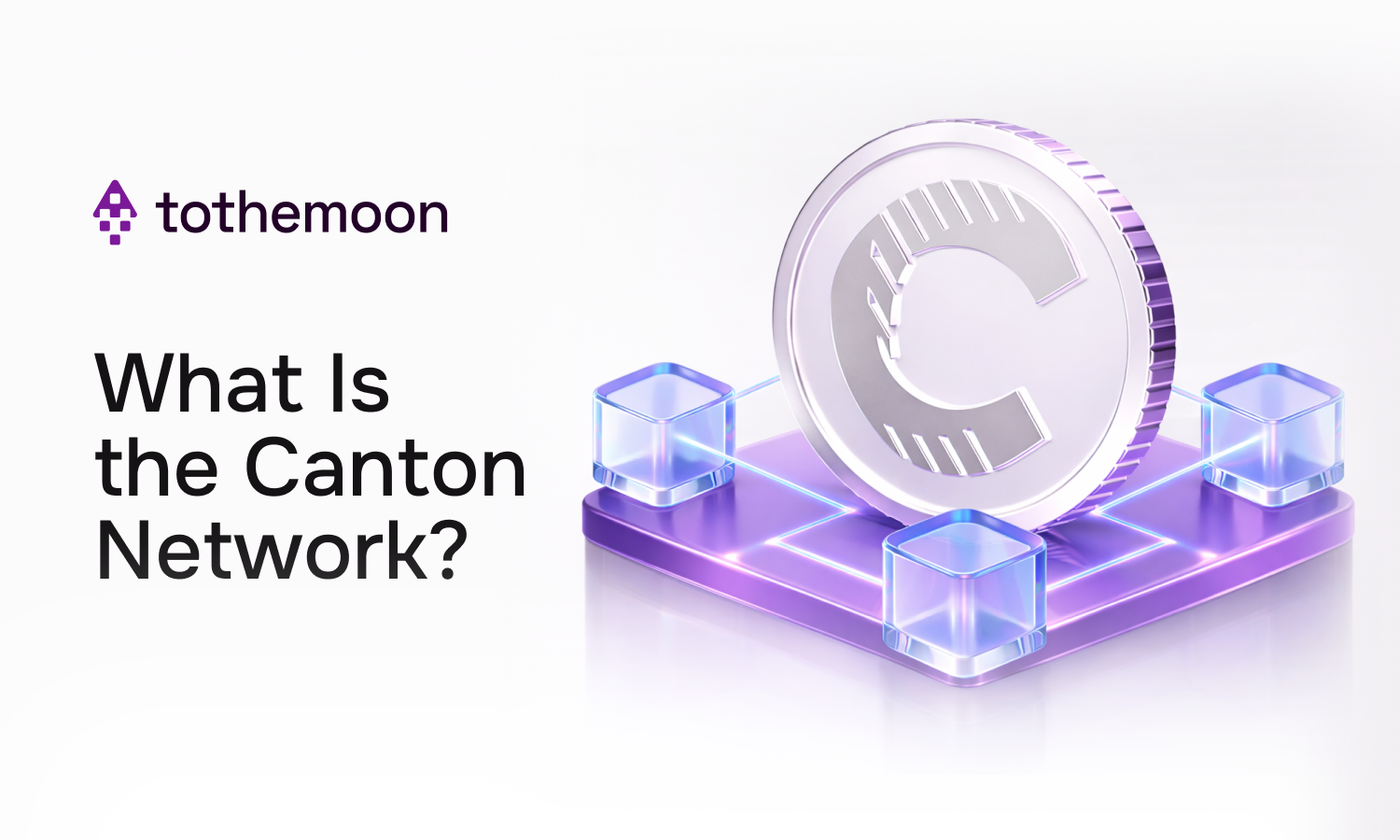
The Canton Network is a public, permissionless blockchain built for real-world financial systems. It connects applications from traditional finance and crypto markets on a shared network while allowing each application to define its own privacy, access, and operational rules.
Public blockchains offer global connectivity but impose uniform transparency and execution models. Financial markets operate with selective disclosure, defined permissions, and strict settlement guarantees. Canton addresses this mismatch by separating openness at the network layer from control at the application layer. Applications can be private or open, permissioned or permissionless, while operating on the same public network and interoperating when required.
The network supports more than six trillion dollars in onchain assets, processes trillions of dollars in repo activity each month, and operates with hundreds of validators distributed globally.
Public network, configurable applications
The Canton Network operates as a public network. Participation at the network layer is open, subject to protocol rules and governance. At the application layer, developers define:
- Who can access the application;
- What data is visible to each participant;
- How workflows are governed and operated.
A regulated, KYC-gated financial product and an open-access developer application can coexist on the same network and interact selectively. This mirrors how the internet functions as a public system while supporting both open and restricted services.
This separation allows financial workflows to share infrastructure without exposing sensitive data or forcing unrelated applications to operate under the same constraints.
Architecture overview
Canton is structured as a network of independently operated applications rather than a single global ledger. Each application:
- Maintains its own governance model and service-level agreements;
- Operates on partitioned state;
- Runs its own supporting infrastructure.
Data is shared only with parties directly involved in a transaction.
Synchronization and cross-application coordination
Cross-application transactions rely on synchronization services that coordinate transaction ordering and finalization. The Global Synchronizer is a decentralized deployment of the Canton protocol that:
- Time-orders cross-application transactions;
- Prevents conflicts between independently governed applications;
- Coordinates cryptographic proofs between participants.
Transaction data is not replicated across the network. Participants receive only the information required to confirm consistent outcomes. Applications may rely on the Global Synchronizer or operate private synchronizers based on preferences around performance, trust assumptions, and metadata disclosure.
Smart contracts and execution model
Applications on Canton are built using Daml, a smart contract language designed for multi-party financial workflows. Daml contracts provide:
- Data minimization, where only relevant parties receive transaction details;
- Built-in authorization rules encoded directly in contract logic;
- Deterministic execution across participants.
Contracts specify who may see, create, exercise, or archive rights. Participants outside a given contract observe cryptographic commitments sufficient for global consistency, without access to underlying data. This design supports composable workflows across applications with different privacy policies.
Atomic composability and cross-application safety
Financial infrastructure requires transactions across multiple systems to settle consistently. Partial settlement introduces counterparty risk, operational complexity, and reconciliation overhead.
Canton supports atomic transactions across independently governed applications. When a transaction takes place multiple applications or assets, all related state changes finalize together or none finalize at all.
This applies when:
- Applications operate under different governance models;
- Privacy rules differ across workflows;
- Infrastructure is operated by separate entities.
Cross-application atomicity is handled at the protocol level rather than through external messaging, bridges, or asynchronous settlement mechanisms.
Many public blockchains route privacy-sensitive activity through subnets, sidechains, or Layer 2 systems. These designs introduce delays, trust assumptions, and settlement gaps. Canton maintains atomic coordination across the network without fragmenting execution environments.
For workflows such as delivery-versus-payment, collateral substitution, and multi-asset financing, atomic composability is a structural requirement rather than an optimization.
Privacy model and selective disclosure
Canton applies privacy at the level of individual smart contracts and transactions rather than at the level of entire chains or subnets.
Visibility rules are defined directly in contract logic. Parties receive only the portions of a transaction that relate to their role. Data is shared on a need-to-know basis, even when workflows span multiple applications.
This model mirrors traditional financial systems:
- A bank sees all accounts held at that institution;
- An individual sees their own accounts across institutions;
- Counterparties see only the data required for a specific transaction.
Canton supports sub-transaction level disclosure. In a delivery-versus-payment workflow:
- The cash leg is visible only to payment participants;
- The asset leg is visible only to the registrar or custodian;
- Other participants observe cryptographic commitments sufficient for consistency.
Infrastructure operators and validators do not have access to transaction contents. They observe limited metadata required for ordering and confirmation, without visibility into balances, positions, or counterparties.
This differs from private sidechains and subnet models, where participants inside a domain often see all activity, and participants outside see nothing. It also differs from zero-knowledge and other encryption approaches, which remain limited in scope and operational maturity for regulated finance.
Performance and scalability
Canton scales through independent application infrastructure rather than global state replication.
Key Characteristics:
- Partitioned state per application;
- Independent compute and storage scaling;
- No global contention between unrelated applications.
When applications interact, synchronization services coordinate transaction ordering and finalization. Additional synchronizers can be deployed as activity grows, allowing capacity to increase horizontally without introducing shared execution bottlenecks.
Governance and ecosystem participation
Protocol evolution is coordinated through the Canton Foundation and a public improvement proposal process.
Canton Improvement Proposals define changes to:
- Protocol behavior;
- Configuration standards;
- Ecosystem programs.
Proposals are reviewed and adopted through participation by Super Validators and the broader community.
The foundation includes participants from global banks, financial market infrastructure providers, and crypto-native firms. This governance structure reflects the network’s role as shared financial infrastructure rather than an application-specific platform.
An expanding ecosystem of wallets, custodians, exchanges, and access providers supports participation across regulated and permissionless use cases.
Conclusion
Canton Network applies a distinct model to public blockchain design. The network remains open and permissionless, while applications retain control over privacy, access, and operational policies. This separation supports shared infrastructure without exposing confidential data or limiting composability.
Through atomic cross-application coordination, contract-level privacy, and horizontally scalable architecture, Canton supports financial activity at institutional scale. It operates as neutral infrastructure where assets, applications, and participants connect continuously across traditional and decentralized markets.

Risk Disclosure Statement
.jpeg)


.svg)
.svg)
.svg)