.svg)
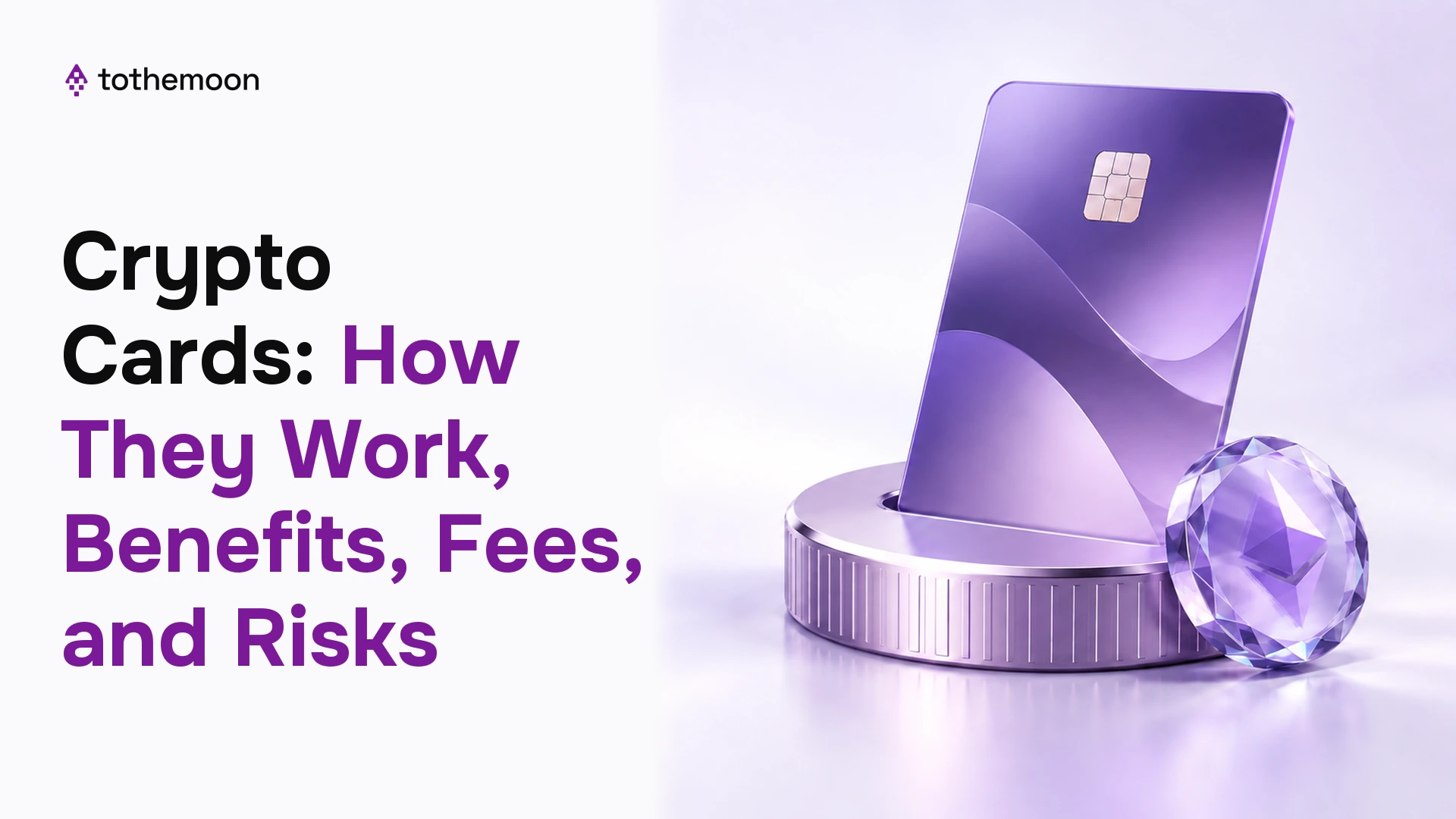
Crypto Cards: How They Work, Benefits, Fees, and Risks
Crypto cards let you use eligible digital assets for card purchases and, in some cases, cash withdrawals. Most do not send cryptocurrency to the merchant. Instead, the provider checks your crypto balance, converts the required amount into the card's settlement currency, and completes the payment through conventional payment infrastructure. The exact timing, rate, and fees depend on the product.
What's in this article
- What a crypto card is and how it differs from a standard bank card
- Which debit, prepaid, and credit models exist
- Which fees, exchange rates, limits, and eligibility rules to check
- How a crypto card payment moves from authorization to settlement
- What benefits crypto cards can offer
- Which operational and security risks matter
- How to compare crypto card providers before applying
- Whether crypto card purchases can create a taxable event
- How the Tothemoon Card works for eligible users
What is a crypto card?
A crypto card is a payment card connected to a cryptocurrency balance or account. It gives the user a familiar card experience while the provider handles the conversion needed to pay a merchant in fiat currency. Depending on the programme, the card may be virtual, physical, or both.
The name can be misleading. A shop usually does not receive bitcoin, ether, or another digital asset from the customer. The merchant sees an ordinary card payment in a supported currency, while the crypto-related activity happens behind the scenes. This arrangement connects two systems: a digital-asset platform that tracks the user's balance and traditional payment infrastructure that authorizes and settles the purchase.
That connection also explains why several organizations may be involved. A crypto platform may provide the app and wallet, a regulated issuer may issue the card, a processor may manage payment messages, and a card network may carry the transaction. The roles and protections can differ by provider and jurisdiction. Understanding how cryptocurrency moves across borders also helps separate an onchain transfer from a card payment that crosses payment networks.
Is a crypto card a debit, prepaid, or credit card?
Crypto cards can use debit, prepaid, or credit-like models, so the word “crypto” alone does not tell you how the product is funded. Check the legal terms and understand the fiat on-ramp or other source of funds before comparing rewards or convenience.
Crypto debit cards
A crypto debit card spends from an available balance. The provider may convert crypto at the moment of purchase or debit a fiat balance that you funded earlier. There is normally no revolving loan, but authorization holds and delayed completion can still affect your available balance.
Crypto prepaid cards
A prepaid model requires you to load value before spending. You may first sell crypto and move the proceeds to a separate card balance. This adds a step, but it can make the amount available for card spending easier to see.
Crypto credit and rewards cards
Some cards extend credit in fiat and award cryptocurrency as a benefit. Others may require digital assets as collateral. These products involve different borrowing costs, repayment terms, liquidation risks, and consumer protections. They should not be evaluated like a simple debit card. If rewards influence your choice, first understand how crypto rewards work and which risks matter.
What fees and exchange rates can apply?
The true cost of a crypto card is the combined effect of its conversion rate, card fees, foreign-exchange treatment, and any limits. A zero issuance fee does not necessarily mean that every transaction is free.
Before using a card, look for these possible charges:
- crypto-to-fiat conversion fees or a spread built into the quoted rate
- card transaction or service fees
- foreign-exchange fees when the purchase currency differs from the card currency
- ATM withdrawal fees charged by the card provider or ATM operator
- physical card issuance, delivery, replacement, or inactivity fees
- declined-transaction, chargeback, or other programme-specific fees
The exchange-rate policy matters as much as the published fee. Check which price source the provider uses, when the rate is locked, how long authorization holds can remain, and where a refund is credited. Depending on the programme, a refund may return to a fiat card balance, a platform wallet, or another designated balance. If it is converted again, the amount of crypto can differ because the asset price or currency rate may have changed.
Also review daily and monthly purchase limits, ATM limits, minimum balances, and restricted merchant categories. Limits can change by verification level, location, or programme rules. Always use the provider's current fee schedule rather than relying on an older review or promotion.
How does a crypto card payment work?
A crypto card payment usually converts enough of a selected digital asset to cover a fiat-denominated card transaction. The precise sequence varies, but a typical purchase follows six steps.
- You select a funding asset. In the card app, you choose an eligible cryptocurrency or a supported account balance. Some cards let you set an order of assets; others support only one linked asset at a time.
- The merchant requests authorization. When you tap, insert, or enter the card online, the merchant sends the transaction amount through its acquiring bank and the card network.
- The provider checks the available balance. The card programme confirms that your eligible balance can cover the purchase, estimated conversion, and any applicable fees. A temporary authorization hold may reduce the amount you can spend until the transaction is completed or released.
- Crypto value is converted. The provider calculates how much of the selected asset is required at its applicable rate. Conversion may happen during authorization, after the payment is finalized, or through a prefunded fiat balance. The product terms should explain the method.
- The merchant receives fiat settlement. The card network completes the transaction using the card's settlement currency. From the merchant's perspective, this generally looks like another card payment.
- The final amount is reconciled. Tips, exchange-rate changes, partial captures, reversals, or refunds can make the final debit differ from the initial hold. Your app should show the completed transaction and the crypto or fiat value used.
This is different from paying a merchant directly onchain. An onchain payment transfers a digital asset between blockchain addresses. A crypto card translates digital-asset value into a payment that existing card terminals and online checkout systems can accept.
What are the main benefits of crypto cards?
The main benefit of a crypto card is practical access: it can turn eligible digital-asset value into a familiar way to pay without requiring every merchant to accept cryptocurrency directly.
- Everyday acceptance. A card-network payment can work at supported physical and online merchants even when they do not have a crypto checkout option.
- Less manual conversion. Some products remove the need to sell crypto and withdraw fiat before each purchase.
- One app for management. A provider may combine balance selection, card controls, transaction history, and security notifications in one interface.
- Virtual-card access. Where available, a virtual card can support online purchases and compatible mobile wallets without waiting for a physical card.
- Clearer spending boundaries. A debit or prepaid model can limit spending to the balance made available to the card, although holds and fees still need to be considered.
Convenience does not make a crypto card the right tool for every payment. Spending an asset also gives up any future exposure to that asset, and conversion can create costs or reporting obligations. Users who need to acquire crypto first should understand the complete acquisition and spending journey.
What risks should crypto card users understand?
Crypto cards combine digital-asset, payment-card, and provider risks. They can be convenient, but users should understand what can change between holding an asset and completing a purchase.
- Price volatility. The value of a linked cryptocurrency can move before authorization or final settlement. A declining balance may leave too little value to complete a purchase or cover a later adjustment.
- Conversion uncertainty. Spreads, rate-lock timing, and currency conversion can make the effective cost higher than the displayed purchase price.
- Authorization holds. Hotels, fuel stations, car rentals, and restaurants may place holds above the expected final amount. That value can remain unavailable until the hold is released.
- Provider dependencies. Card access can depend on the platform, issuer, processor, network, and applicable rules. An outage or compliance review at one layer may interrupt the service.
- Custody and account security. If the card uses assets held with a provider, account compromise could expose both the wallet and card functions. Strong authentication, device security, transaction alerts, and a rapid card-freeze option are important.
- Refund and dispute complexity. A card refund is generally returned through card rails, but its conversion back to fiat or crypto depends on the programme. Read the dispute and chargeback process before a problem occurs.
- Eligibility and availability changes. Countries, assets, card types, limits, and features may change. Approval is not guaranteed simply because the provider advertises a card.
- Tax and record-keeping. Spending crypto can be treated as disposing of an asset in some jurisdictions. Users may need records of acquisition cost, conversion value, fees, and transaction date.
Do not keep more value in a card-linked balance than you are comfortable exposing to the product's operational and custody model. Review the provider's terms, risk disclosures, and security controls, and seek qualified tax or legal advice where needed.
How should you compare crypto card providers?
Compare providers by following the full payment journey, not just the headline reward or fee. A strong option should make eligibility, conversion, security, and support understandable before you deposit or spend funds.
- Confirm eligibility. Check supported countries, age and residency rules, identity-verification requirements, and whether the card is available to individuals, businesses, or both.
- Identify the card model. Determine whether it is debit, prepaid, or credit, who issues it, which network it uses, and what currency the card is denominated in.
- Check supported assets. Verify which cryptocurrencies can fund purchases, how you select one, and what happens when the chosen balance is insufficient. If several asset types are available, understanding the differences between stablecoins and altcoins can help you assess volatility and conversion needs.
- Calculate the full cost. Combine conversion spread, transaction fees, foreign exchange, ATM costs, issuance, delivery, and ongoing charges. Test the provider's quote against a small example.
- Review timing and holds. Find out when the rate is fixed, how tips and offline transactions are handled, and how long authorization holds and refunds can take.
- Inspect limits and restrictions. Check purchase and withdrawal limits, prohibited merchant categories, geographic restrictions, and rules for physical or virtual cards.
- Evaluate security controls. Look for strong authentication, instant notifications, card freeze or block controls, PIN management, and a clear process for a lost device or unauthorized transaction.
- Understand custody. Learn whether assets remain in a platform wallet, move to a separate card balance, or serve as collateral. Check what happens if the account or card service is restricted.
- Read the dispute process. Confirm how to contact support, challenge a card transaction, request a chargeback, and track a refund.
- Verify current terms. Use official product pages and legal terms. Features described by third parties may be incomplete or outdated.
Do crypto card purchases create a taxable event?
They may. In many tax systems, using cryptocurrency to buy goods or services can count as disposing of the asset, which may create a gain or loss based on the difference between its acquisition cost and value when spent. The treatment varies by country, asset, user type, and transaction.
Keep records of the asset amount, fiat value, date, conversion rate, and fees for each purchase. Do not assume that a card transaction avoids crypto reporting merely because the merchant receives fiat. Consult current guidance from your local tax authority or a qualified professional for advice about your circumstances.
How can Tothemoon help?
The Tothemoon Card is a EUR-denominated debit card on the Mastercard network for eligible EEA residents. It allows users to spend eligible digital assets held in their Tothemoon Spot Wallet on online and offline purchases and ATM withdrawals, with the selected asset converted into EUR for card transactions. Eligibility, identity verification, limits, supported assets, and other programme conditions apply.
Eligible users can apply through the Tothemoon mobile app. The app also provides card-management features such as blocking the card, requesting a PIN change, and viewing transaction history.
Before applying or spending, review the current card terms and Tothemoon fees, confirm that the product is available in your location, and check the current eligible payment assets, card transaction fees, and card limits. If the card fits your needs, start with the official Tothemoon Card page.

Risk Disclosure Statement
.jpeg)


.svg)
.svg)
.svg)