.svg)
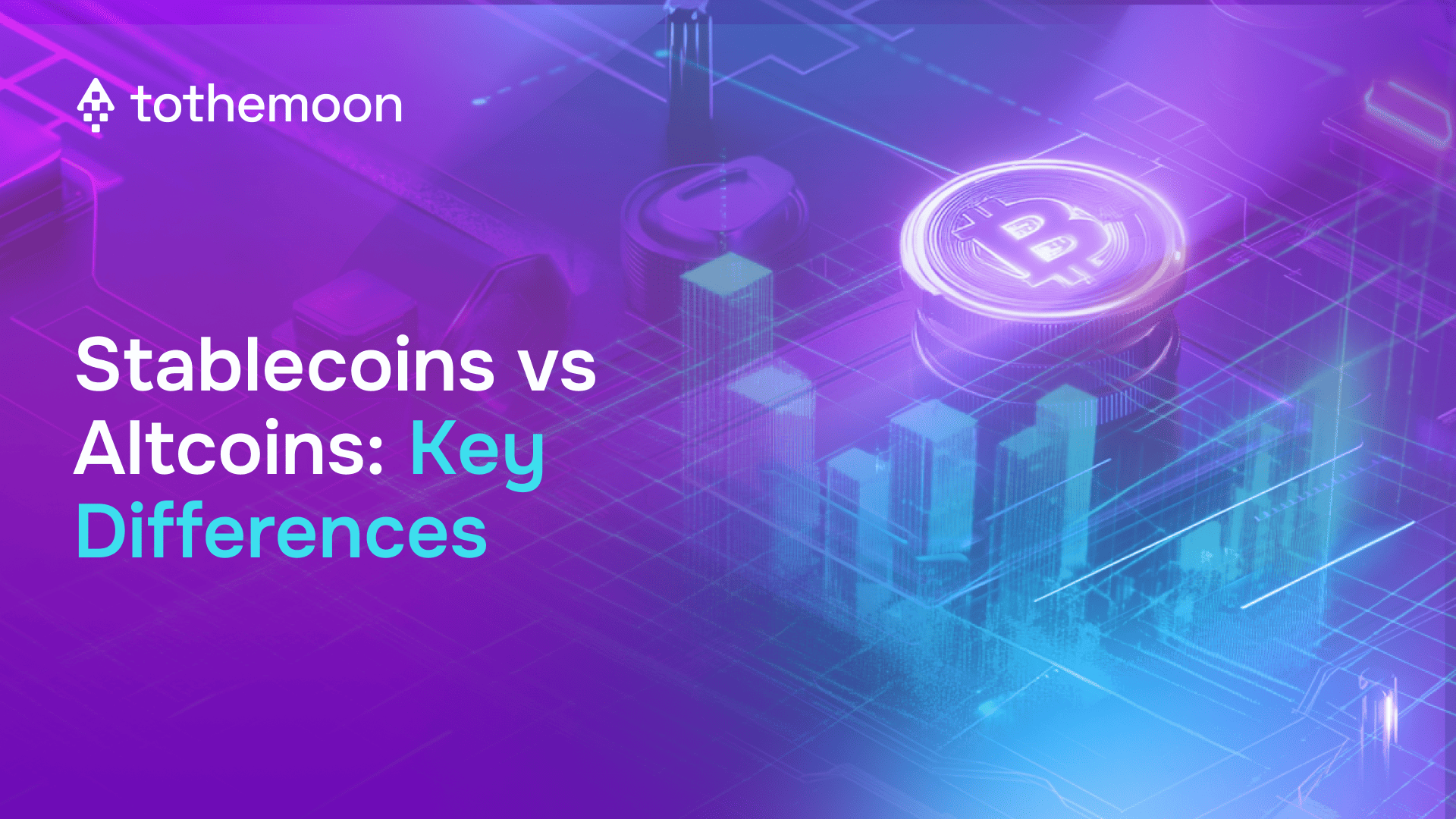
Stablecoins vs Altcoins: Key Differences
Most people new to crypto sort the market into Bitcoin and "everything else." That second group is where the confusion starts, because it holds two very different kinds of assets: altcoins built to grow in value, and stablecoins built to hold a fixed value. Knowing which is which changes how you trade, save, and move money on-chain.
This guide explains what stablecoins and altcoins are, how they differ across price, purpose, backing, and risk, and how to decide which one fits a given use.
In this article
- What are altcoins?
- What are stablecoins?
- Key differences between stablecoins and altcoins
- Types of altcoins
- Types of stablecoins
- Use cases: when each one is used
- Risks of stablecoins and altcoins
- Stablecoins vs altcoins: which should you choose?
- Frequently asked questions
What Are Altcoins?
An altcoin is any cryptocurrency other than Bitcoin. The name is short for "alternative coin," and the category covers thousands of assets, from large networks like Ethereum and Solana to smaller utility and governance tokens.
Altcoins were created to do things Bitcoin was not designed for. Ethereum introduced programmable smart contracts, while other networks focus on faster transactions, lower fees, privacy, or specialized applications. Their value comes from utility, adoption, and market demand, which means prices can rise sharply and fall just as fast.
What Are Stablecoins?
A stablecoin is a cryptocurrency designed to hold a steady value, usually pegged one-to-one to a currency such as the US dollar. The two largest, USDT and USDC, are each meant to stay at about $1 regardless of what the wider market does.
Stablecoins exist to solve the volatility problem. They let people hold value, settle payments, and trade in and out of positions without leaving the crypto system or worrying that the asset will lose value mid-transfer. In practice, they act as the dollars of the crypto market.
A stablecoin is technically a type of altcoin, since it is a non-Bitcoin cryptocurrency. The reason the two are compared separately is that they are built for opposite purposes: altcoins for growth, stablecoins for stability.
Key Differences Between Stablecoins and Altcoins
The two asset classes differ across every dimension that matters to a user or business.
- Purpose. Altcoins are built to deliver functionality or grow in value. Stablecoins are built to preserve value and serve as a reliable medium of exchange.
- Price behaviour. Altcoin prices move with the market and can swing widely in a single day. A working stablecoin moves only a fraction of a cent around its peg.
- Backing. Most altcoins have no external backing. Their value rests on utility and demand. Stablecoins are backed by reserves, crypto collateral, or supply rules designed to hold the peg.
- Return potential. Altcoins can deliver large gains and large losses. Stablecoins are not designed to appreciate, so the return comes from yield or utility rather than price.
- Risk profile. Altcoins carry market risk. Stablecoins carry peg and reserve risk, which is a different exposure rather than a smaller one.
- Primary role. Altcoins are mainly held as investments or used to access a network. Stablecoins are mainly used for payments, settlement, and as a safe place to park value.
Types of Altcoins
Altcoins are not a single category. The main groups include:
- Payment and store-of-value coins such as Litecoin, used mainly for transfers.
- Smart contract platforms such as Ethereum and Solana, which run decentralized applications.
- Utility tokens that grant access to a specific service or pay network fees.
- Governance tokens that give holders voting rights in a protocol.
- Meme coins driven largely by community and speculation, with little underlying utility.
Types of Stablecoins
Stablecoins also fall into distinct groups based on how they hold their peg:
- Fiat-backed. Backed by reserves of cash and short-term assets held by an issuer. USDT and USDC are the largest examples.
- Crypto-collateralized. Backed by other cryptocurrencies locked in a smart contract, with extra collateral posted to absorb price swings. DAI is the main example.
- Algorithmic. Use supply rules rather than reserves to hold the peg. These have proven the most fragile, as the collapse of TerraUSD in 2022 showed.
Use Cases: When Altcoins and Stablecoins Are Used
The right asset depends on the goal.
Stablecoins are used for:
- Sending payments and cross-border transfers that settle in minutes without value loss
- Trading in and out of positions without converting back to fiat
- Holding value during volatile market conditions
- Earning yield through lending and staking
Altcoins are used for:
- Investing with the aim of price appreciation
- Paying transaction fees on their native networks
- Accessing decentralized applications and services
- Participating in protocol governance
Risks of Stablecoins and Altcoins
While both stablecoins and altcoins carry risk, the risk is not the same.
Altcoin Risks
Altcoin risks are mainly about price. Values can fall sharply, smaller projects can fail, and low-liquidity tokens can be hard to exit. Some projects also carry technical or governance weaknesses.
Stablecoin Risks
In the case of stablecoins, the main risk involved is about the peg. A stablecoin can lose its peg if its reserves are insufficient, poorly disclosed, or held with a troubled banking partner. Algorithmic models carry the highest risk, since they depend on confidence rather than assets.
Stablecoins vs Altcoins: Which Should You Choose?
There is no single answer on which option you should use, because the two serve different jobs. The deciding factors are your goal, your tolerance for price swings, and the time horizon you are working with. A few practical guidelines:
- Choose stablecoins when the priority is preserving value, moving money, or settling payments. They suit treasury balances, payouts, and any flow where price swings would be a problem.
- Choose altcoins when the priority is exposure to growth or access to a specific network or application, and when you can accept the volatility that comes with it.
- Use both if your goals include both moving value reliably and seeking upside. Many holders keep a stablecoin balance for spending and settlement alongside altcoin positions held for the longer term.
Frequently Asked Questions
Are stablecoins altcoins?
Technically yes. Any cryptocurrency that is not Bitcoin is an altcoin, and that includes stablecoins. They are compared separately because stablecoins are built for stability while most altcoins are built for utility or growth.
Is USDT a stablecoin or an altcoin?
USDT is a stablecoin, and a stablecoin is a specific type of altcoin. It is pegged to the US dollar and designed to stay at about $1.
Which is safer, stablecoins or altcoins?
Stablecoins are less exposed to price swings, but they are not risk-free. They carry peg and reserve risk, while altcoins carry market risk. Neither is automatically safer in every sense.
Can you earn returns with stablecoins?
Stablecoins are not designed to rise in price, so returns come from yield through lending or staking rather than appreciation. Altcoins offer price upside but with far higher risk.
Explore Tothemoon Solutions
Tothemoon operates across the layers that matter most for both users and businesses. The exchange supports spot and perpetual futures trading across 350+ cryptocurrencies with both centralized matching for deep liquidity and non-custodial staking for users who want to keep their own keys.
For institutional users, mass payouts distribute stablecoin payments across Ethereum, Tron, Solana, and major Layer 2 networks in a single batch. For affiliate and partner programs, the program pays 70% lifetime commission with daily payouts and no minimum threshold.

Risk Disclosure Statement
.jpeg)


.svg)
.svg)
.svg)