.svg)
Programmable Payments: How Smart Contracts Change Business Transactions
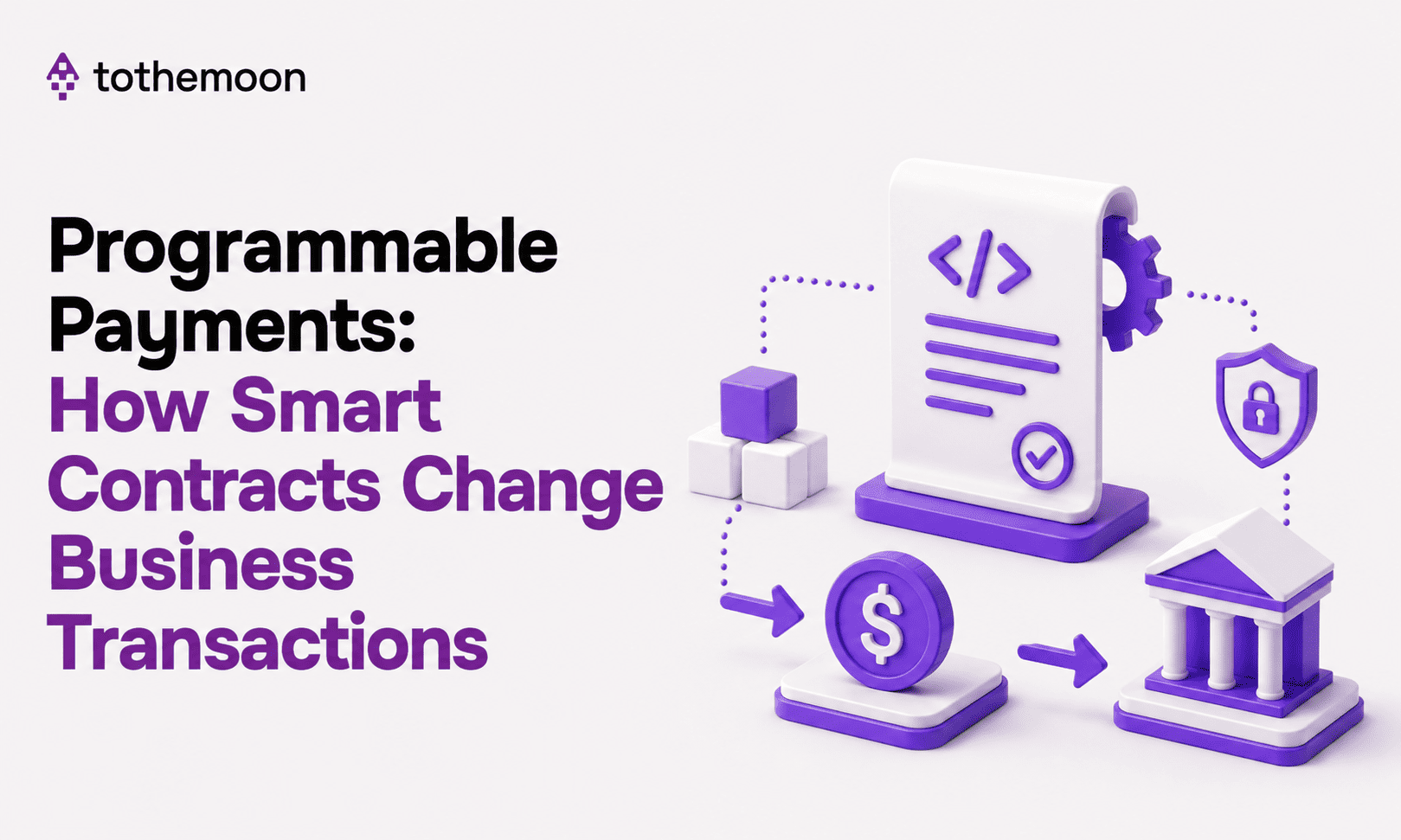
Programmable payments use software logic to control when, how, and under what conditions value moves. In blockchain environments, that logic often runs through smart contracts, which can execute payment rules on-chain once predefined conditions are met.
For businesses, this changes the payment conversation. A payment is no longer only a transfer after an invoice, checkout, or manual approval. It can become part of a workflow: release funds after delivery, split revenue between participants, route stablecoin payouts, hold funds until conditions are met, or update balances automatically.
Programmable payments can make business transactions faster and more flexible, but they also require careful design. Code can automate a rule, but the business still needs controls around security, compliance, settlement, refunds, and exceptions.
What Are Programmable Payments?
Programmable payments are payment flows where rules are embedded into software. Those rules might define payment timing, recipient logic, fee calculation, release conditions, refund handling, or approval requirements.
In traditional systems, programmable logic often sits inside payment platforms, banking software, accounting tools, or enterprise systems. In blockchain-based systems, smart contracts can execute certain payment rules directly on a blockchain.
This can be useful when multiple parties need a shared record of payment activity, when settlement should happen outside banking hours, or when digital assets such as stablecoins are used for global value movement.
How Smart Contracts Change Payment Flows
Smart contracts can move payment logic closer to the transaction itself. Instead of relying only on manual instructions or back-office processing, the contract can enforce certain rules automatically.
Automated Settlement
A smart contract can release funds when a condition is met. That condition might be a delivery event, time period, approved milestone, account balance, or external signal.
For businesses using on-chain settlement, this can reduce manual payment steps. The business still needs reliable data and clear rules for what counts as completion.
Revenue Splitting
Programmable payments can split funds between multiple recipients. A marketplace may route a percentage to a seller, a fee to the platform, and a commission to a partner. A creator platform may distribute revenue between contributors.
This can reduce manual reconciliation, especially when payments are frequent or involve many parties. The business still needs reporting that connects each split to orders, users, fees, and tax records.
Escrow-Like Workflows
Smart contracts can hold funds until a release condition is satisfied. This can support milestone payments, deposits, marketplace transactions, or conditional settlement.
The word "escrow" should be used carefully because legal escrow has specific requirements in many jurisdictions. From a business perspective, the important point is that smart contracts can hold and release value according to coded rules, while legal obligations still need separate review.
Stablecoin Payout Logic
Businesses can use stablecoin payments for payouts to contractors, affiliates, sellers, or users. Smart contracts can help define payout timing, recipient splits, and payment conditions.
This can be useful for global payout programs, but it also requires wallet validation, sanctions screening, liquidity planning, and clear support rules for failed or delayed transactions.
Business Benefits of Programmable Payments
Programmable payments can improve operations when a business has repeated payment rules, many participants, or cross-border flows.
Faster Execution
Once conditions are met, smart contracts can execute without waiting for manual batch processing. This can reduce delays in marketplace settlement, supplier payments, affiliate payments, or treasury movement.
Faster execution is useful only when the rules are correct. A badly designed condition can release funds too early, too late, or to the wrong recipient.
Clearer Transaction Logic
Smart contracts can make payment logic visible and consistent. The same rule can apply each time, and transactions can often be verified through a blockchain explorer.
For finance teams, this visibility becomes valuable when it is connected to internal records. A transaction hash should map to a customer, invoice, order, payout, fee, or settlement event.
Better Multi-Party Coordination
Business transactions often involve more than one party. Programmable payments can help coordinate sellers, platforms, affiliates, contractors, liquidity providers, and customers.
When combined with blockchain payment solutions, programmable logic can support payment flows that operate across markets and time zones.
Risks Businesses Need to Manage
Programmable payments can reduce manual work, but they create new risks.
Code and Logic Risk
If the smart contract has a bug, the payment flow can fail or execute incorrectly. The business should review audits, testing, upgrade controls, and incident response before relying on automated payments.
Data and Oracle Risk
Some programmable payments depend on external data. If that data is wrong, delayed, or manipulated, the payment may execute incorrectly. Businesses should understand which data sources trigger payment actions.
Exception Handling
Traditional payment operations often rely on human review for exceptions. Smart contracts need explicit rules for what happens when an order is canceled, a delivery fails, a customer overpays, or a recipient wallet is wrong.
Exception handling should be designed before launch. Otherwise, automated payments can create support problems that are harder to fix after funds move.
Security and Permissions
Programmable payments may depend on admin keys, contract upgrades, wallet approvals, and provider integrations. Weak permissions can create direct financial risk.
Crypto security should cover contract administration, signer roles, API access, and monitoring, not only wallets that hold balances.
When Programmable Payments Make Sense
Programmable payments are most useful when payment rules repeat often, involve several parties, or depend on conditions that can be verified reliably. Marketplaces, affiliate programs, digital services, subscription platforms, cross-border payouts, and treasury workflows may all benefit.
They may be less useful when payments are rare, exceptions are frequent, or the business cannot define clear conditions for automated execution. In those cases, a traditional payment workflow with manual review may be safer and easier to operate.
Conclusion
Smart contracts change business transactions by moving some payment rules into executable code. They can automate settlement, split revenue, support conditional releases, and make stablecoin payment flows more flexible.
The business still needs to decide which rules belong in code and which should stay in contracts, policies, support workflows, or manual review. Programmable payments work best when automation is paired with audits, monitoring, wallet controls, compliance checks, and clear procedures for exceptions.
Explore Tothemoon Solutions
Tothemoon is an all-in-one crypto platform built for both institutional and retail users. For our institutional clients, we offer on-ramp and off-ramp solutions, advanced trading and OTC desk services, crypto processing, mass payouts, API integration, staking, and dedicated concierge support. Our product suite for retail clients offers spot trading, futures, staking, and a versatile crypto card for everyday spending. Tothemoon bridges accessibility with professional-grade tools, making crypto practical and efficient for all.

Risk Disclosure Statement
.jpeg)


.svg)
.svg)
.svg)