.svg)
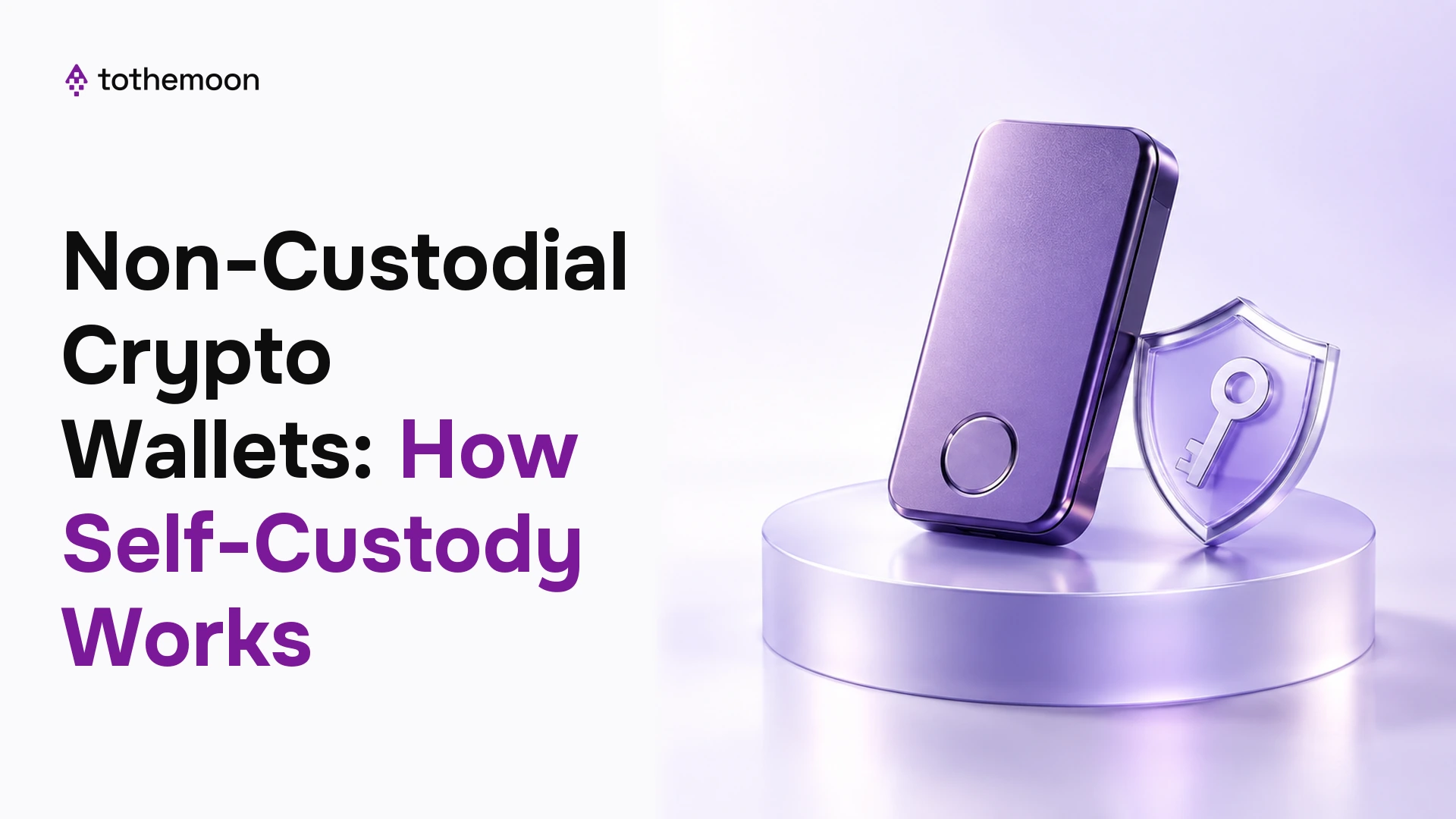
Non-Custodial Crypto Wallets: How Self-Custody Works
A non-custodial crypto wallet lets you authorize blockchain transactions without asking a custodian to act for you. You control the signing credentials, so you also carry the responsibility for backups, device security, transaction checks, and recovery. The practical question is whether you can operate that process reliably, not whether self-custody is universally better.
What's in this article
- What a non-custodial wallet controls and what remains on the blockchain
- How a self-custody transaction works from signing to confirmation
- How non-custodial and custodial wallets differ
- Which wallet formats are available
- What benefits and risks come with self-custody
- How to set up, use, and evaluate a wallet
- When a custodial account may be more practical
- How Tothemoon supports transfers to external wallets
What is a non-custodial crypto wallet?
A non-custodial crypto wallet is software or hardware that lets its user control the credentials required to authorize transactions. It is often called a self-custody wallet because a third-party custodian does not hold those credentials on the user's behalf.
The wallet does not store coins in the same way a physical wallet stores cash. Crypto assets are recorded on a blockchain. The wallet manages the private keys, recovery information, and interfaces used to view addresses and sign instructions.
Control depends on the wallet design. A conventional wallet may derive multiple private keys from a recovery phrase. A multisignature wallet can require several keys. Some multiparty computation systems distribute signing material so that no single device holds a complete key. Smart contract wallets can apply programmable approval and recovery rules. The common feature is that the user, or a group chosen by the user, can authorize activity without relying on a central account provider to sign each transaction.
This control has an important consequence. If someone steals the recovery phrase or signing credentials, they may be able to take over the wallet. If the credentials are lost and no working recovery method exists, a support team generally cannot reset access.
How does a non-custodial wallet work?
A self-custody wallet creates or imports signing credentials, derives public addresses, and signs transaction data locally or through a distributed signing process. The blockchain network, not the wallet company, records the resulting transfer.
- The wallet creates or imports access credentials. A new wallet may generate a recovery phrase, a hardware-protected key, several signer keys, or another recovery setup. Importing an existing wallet restores control from compatible credentials.
- The wallet derives a public address. Other people or services can use this address to send supported assets on the correct network. Sharing a public address does not reveal the private key.
- The user prepares an instruction. The wallet collects the destination address, asset, network, amount, and network fee. Token transfers may also require interaction with a smart contract.
- The transaction is signed. The wallet proves authorization with the relevant key or approval policy. Signing should happen without exposing the secret credential to the website or recipient.
- The signed transaction is broadcast. A node relays it to the selected blockchain network. Once broadcast, editing or cancelling it may be impossible.
- The network validates and records it. Validators or miners check the instruction under the network's rules. A blockchain explorer can show the transaction identifier, status, addresses, fee, and confirmations.
The wallet interface can display an estimated balance and activity, but the relevant blockchain is the authoritative public record for an on-chain transaction. A custodial service receiving the transfer may apply additional confirmation, compliance, or account-crediting steps after the network records it.
How is a non-custodial wallet different from a custodial wallet?
The main difference is who controls transaction authorization. A non-custodial wallet gives that control to the user or the user's chosen signers. A custodial wallet gives it to a service provider that maintains an account balance and processes instructions under its terms and controls.
That difference changes several practical outcomes:
- Key control: A self-custody user manages the signing credentials. A custodian manages the keys or custody infrastructure for the account.
- Recovery: A custodial provider may offer account-recovery procedures. A non-custodial wallet can be recovered only through its own configured method, such as a recovery phrase, backup, guardians, or multiple signers.
- Transaction approval: Self-custody transactions can be signed directly. Custodial withdrawals may pass account, security, compliance, limit, and operational checks before broadcast.
- Counterparty exposure: Self-custody reduces dependence on a custodian's continued access and solvency. It replaces part of that exposure with personal or organizational key-management risk.
- Support boundaries: A wallet developer can help with software questions, but it usually cannot reverse a confirmed transfer or recreate missing credentials.
Neither model is automatically safer. The better fit depends on the user's technical ability, recovery needs, transaction frequency, asset use, and capacity to maintain security. For a business-focused comparison, see custodial vs non-custodial wallets.
What types of non-custodial wallets are available?
Non-custodial wallets can be categorized by where signing happens and how access is recovered. One user may combine several formats, keeping a small operational balance in a convenient wallet and using a more isolated setup for assets that move less often.
Mobile, browser, and desktop wallets
Software wallets run on an internet-connected device and are often called hot wallets. They are convenient for regular transfers, decentralized applications, and checking balances. Their security depends heavily on the device, operating system, browser, extensions, and the user's ability to recognize phishing attempts.
Hardware wallets
A hardware wallet keeps signing keys in a dedicated physical device and can authorize a transaction without exposing the key to the connected computer. It can reduce certain online attack risks, but the user must still verify transaction details on the device, protect recovery material, and avoid counterfeit or tampered hardware.
Multisignature wallets
A multisignature wallet requires a defined number of separate keys to approve an action. For example, a policy might require two approvals from three possible signers. This can reduce single-person or single-device risk, but it adds coordination and recovery complexity.
MPC and smart contract wallets
Multiparty computation can divide signing across several parties or devices without reconstructing one complete private key in one place. Smart contract wallets can add spending limits, batched actions, guardians, or programmable recovery. These designs may improve control, but they also add provider, implementation, contract, and compatibility risks that users should understand.
The distinction between hot and cold wallets is separate from custody. A non-custodial wallet can be hot or cold, depending on whether its signing environment is connected to the internet.
What are the benefits of self-custody?
Self-custody can give users direct authority over their on-chain assets and reduce reliance on a single account provider. Its main benefits are operational rather than guaranteed financial advantages.
- Direct authorization: The user can sign a compatible on-chain transaction without waiting for a custodian to process a withdrawal request.
- Portability: Standard recovery methods may allow a wallet to be restored in another compatible application or device.
- On-chain access: A compatible wallet can interact directly with supported decentralized applications, smart contracts, staking systems, and token networks.
- Reduced custody dependence: A custodian cannot freeze a wallet it does not control, although networks, token contracts, applications, and regulated counterparties can still impose restrictions.
- Flexible control design: Individuals can choose hardware isolation, while teams can use multisignature or distributed approval policies.
These benefits only hold when the user can protect the credentials and understand the transaction being signed. Control without a workable security and recovery process can become a liability.
What risks come with a non-custodial wallet?
The largest self-custody risks are credential loss, credential theft, deceptive signing requests, and irreversible transaction mistakes. There is usually no central party able to restore the wallet or reverse a valid blockchain instruction.
- Lost recovery access: A destroyed device is recoverable only if the configured backup or recovery process works. A missing phrase, inaccessible signer, or damaged backup can make assets permanently unreachable.
- Phishing and impersonation: Fake wallet applications, browser extensions, support accounts, and websites can trick users into revealing recovery information or approving malicious actions.
- Device compromise: Malware can alter copied addresses, capture screen data, or interfere with a software wallet. Hardware wallets reduce some risks but do not make careless approvals safe.
- Malicious token approvals: A decentralized application may request permission to move tokens. A broad or misleading approval can remain active until it is revoked or the allowance is used.
- Wrong address or network: Sending the right token on the wrong network, omitting a required memo, or using an incompatible address can delay access or cause loss.
- Irreversible transfers: A transaction signed and accepted by the network generally cannot be recalled through a card-style dispute process.
- Smart contract and bridge risk: Self-custody does not protect against flaws or failures in the applications, contracts, tokens, or bridges with which the wallet interacts.
- Physical and personal risk: Visible ownership, weak backups, or poor separation between everyday and reserve wallets can expose a user to theft or coercion.
Privacy is also easy to misunderstand. A non-custodial wallet can be created without a traditional account, but public blockchain activity may be traceable. Using self-custody does not make transactions automatically anonymous or exempt anyone from applicable legal, tax, or compliance obligations.
How can you set up and use a non-custodial wallet safely?
Start with a small, clearly defined use case and build a recovery process before transferring a meaningful balance. Security comes from several controls working together, not from one wallet feature.
- Choose the required network and use case. Confirm which assets, applications, and devices the wallet must support. Do not install several wallets before deciding what each one is for.
- Get the wallet from a verified source. Check the official domain, publisher, application listing, device packaging, and update channel. Avoid wallet links sent through unsolicited messages or search ads you cannot verify.
- Create the wallet privately. Keep cameras, screen sharing, cloud clipboard tools, and other people away from the recovery process. Never provide a recovery phrase to a website or support representative.
- Back up the recovery method offline. Record the exact words, order, signer information, or recovery instructions required by the wallet. Store backups separately from the device and test the process with a low-value wallet where practical.
- Secure the signing devices. Use current software, strong local authentication, device encryption, and a dedicated hardware wallet for higher-risk balances if it fits the use case.
- Fund the wallet with a small test transfer. Verify that the asset, network, address, and any tag or memo match at both ends. Confirm receipt before increasing the amount.
- Review every transaction on the trusted display. Check the destination, network, token, amount, fee, and contract interaction. Do not assume copied addresses or website prompts are correct.
- Separate activities. Consider distinct wallets for regular use, unfamiliar applications, and longer-term storage. Separation can limit the impact of one compromised approval.
- Review permissions and updates. Revoke token allowances that are no longer needed, remove unknown applications, and follow security notices from the wallet's verified channels.
- Prepare an incident plan. Know how to move funds to a new wallet if a device or backup may be compromised. Teams should document signer replacement, approval thresholds, and emergency contacts.
Never test recovery for the first time during an emergency. A backup that has not been checked may contain a transcription error, depend on a missing passphrase, or be incompatible with the intended recovery tool.
How should you choose a non-custodial wallet?
Choose a wallet by matching its security model and supported networks to your actual activity. Popularity alone does not show whether the recovery design, maintenance practices, or transaction interface fit your needs.
- Asset and network support: Verify the exact network version of each asset, not only the token name.
- Key and recovery model: Understand whether the wallet uses a seed phrase, hardware key, multisignature policy, MPC shares, guardians, or a smart account.
- Transaction clarity: The interface should make the destination, network, amount, fee, token approval, and contract action understandable before signing.
- Security evidence: Look for documented architecture, independent audits where relevant, reproducible or open-source components, vulnerability handling, and a clear update history.
- Hardware compatibility: If you plan to use a hardware signer, confirm that the wallet supports the device and the required networks without unsafe workarounds.
- Backup portability: Check what is needed to restore access if the original software, device, or company becomes unavailable.
- Maintenance quality: Review how actively the wallet is updated, how security notices are communicated, and whether old operating systems remain supported.
- Application permissions: Prefer wallets that show contract requests clearly and make it possible to review connected applications and token allowances.
Avoid choosing solely on a promised feature list. A wallet that supports many chains may create more opportunities for network confusion, while a highly specialized wallet may be safer for one use case but unsuitable elsewhere.
When might a custodial wallet be more practical?
A custodial wallet may be more practical when a user needs account recovery, frequent exchange access, managed compliance controls, or a simpler interface and is comfortable relying on a provider. Self-custody may be more suitable when direct on-chain control is essential and the user can operate the required security and recovery process.
Some people use both. A custodial account can support trading and supported deposit or withdrawal routes, while a non-custodial wallet can support direct on-chain activity. Splitting activity does not remove risk, but it can prevent one access model from becoming the only path to every asset.
The important question is not which model sounds more independent. It is who can authorize a transaction, who can help restore access, which controls apply, and which failure modes the user is prepared to manage.
What else should you know about non-custodial wallets?
Does a non-custodial wallet store crypto?
Not literally. The blockchain records the assets associated with addresses. The wallet stores or coordinates the keys and recovery information used to authorize transactions from those addresses.
Can a lost recovery phrase be reset?
Usually not through a central support process. Recovery depends on the wallet design. A conventional seed-based wallet may become inaccessible if both the active device and every valid backup are lost. Guardian, multisignature, MPC, or smart-account systems may provide different recovery paths.
Is a hardware wallet always non-custodial?
A hardware wallet is normally used for self-custody because the user controls the device and recovery material. However, the complete setup matters. A third party could still manage signers, recovery, or transaction policies around a hardware device.
Is a non-custodial wallet anonymous?
Not necessarily. Public blockchains expose transaction histories, addresses, amounts, and contract interactions. Addresses can sometimes be linked to identities through exchanges, applications, payment records, or blockchain analysis.
Is self-custody safer than keeping crypto with a custodian?
Neither model is always safer. Self-custody reduces some counterparty risks but adds direct key, recovery, device, and transaction responsibility. Custody can provide recovery and managed controls but introduces reliance on the provider and its availability, policies, and security.
How can Tothemoon help?
Tothemoon provides eligible users with account-based access to supported crypto-assets and allows withdrawals to external crypto wallets through available networks. This is a custodial service relationship rather than a non-custodial wallet: unless expressly agreed otherwise, users do not have a claim to any specific Tothemoon private key, blockchain address, or on-chain asset.
Before sending assets from Tothemoon to a self-custody wallet, verify the asset, amount, network, wallet address, and any required memo or tag. Also review the current fee, minimum amount, account status, and all withdrawal details before submission. Withdrawals may be subject to supported methods, limits, compliance checks, Travel Rule requirements, security controls, and technical availability. Once an on-chain transfer has been broadcast, it may be irreversible and may be impossible to cancel or recover.
The crypto withdrawal guide explains the current workflow and where to check available networks, minimums, fees, and transaction status. If the route fits your needs, explore Tothemoon and confirm the live transfer details before proceeding.

Risk Disclosure Statement

Svetlana K

Svetlana K. is a marketing and communications professional with a background in media and PR. At Tothemoon, she writes about crypto, blockchain, digital assets, and emerging trends in the industry, turning complex topics into clear, accessible insights.


.svg)
.svg)
.svg)