.svg)
.png)
Custodial vs Non-Custodial Wallets: Benefits and Risks for Businesses
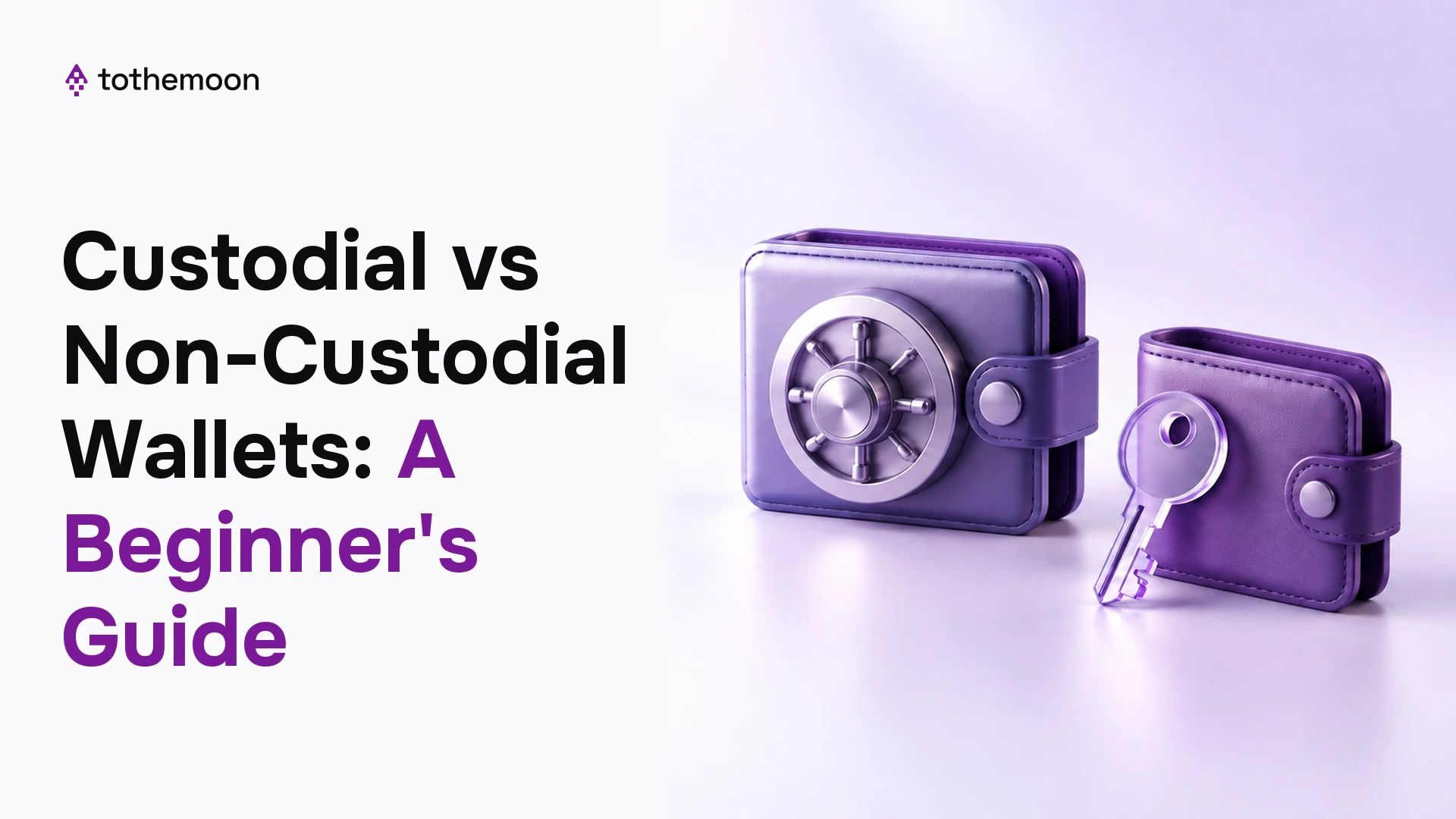
Every business handling crypto has to answer one question before it moves a single coin: who holds the private keys. The answer divides wallets into two categories: custodial wallets and non-custodial wallets.
With a custodial wallet, a third party holds the keys, while with a non-custodial wallet, the business holds them itself. The choice shapes who is responsible for security, who can freeze or recover funds, and what happens if something goes wrong.
This article explains what custodial and non-custodial wallets are, how they compare, and the specific benefits and risks each carries for a business.
In this article
- What is a custodial wallet?
- What is a non-custodial wallet?
- Custodial vs non-custodial wallets: key differences
- Benefits and risks of custodial wallets
- Benefits and risks of non-custodial wallets
- Custodial vs Non-Custodial Wallet: Which Is Best for Your Business?
- Frequently asked questions
What Is a Custodial Wallet?
A custodial wallet is a crypto wallet where a third-party provider holds and manages the private keys for a business. The business can access its account, view balances, set permissions, and request transactions, but the custodian controls the keys that authorise movements on the blockchain.
This model is common among crypto exchanges, payment platforms, and regulated digital asset custodians. Businesses often choose custodial wallets because they simplify crypto storage, transactions, access recovery, and security management.
With a custodial crypto wallet, the provider handles key generation, secure storage, transaction signing, and risk controls. These may include withdrawal limits, multi-user approvals, address allowlists, two-factor authentication, cold storage, and transaction monitoring.
What Is a Non-Custodial Wallet?
A non-custodial wallet is a crypto wallet where the business controls its own private keys. This model is also called self-custody, and it gives the business direct control over its digital assets.
With a non-custodial wallet, no third party can move funds, freeze an account, block a transaction, or recover access on the business’s behalf. The wallet provider may supply the software or hardware interface, but it does not hold the private keys.
Examples include software wallets such as MetaMask, hardware wallets such as Ledger, and institutional self-custody systems used by larger crypto operations.
With non-custodial wallets, the business does not need to rely on an exchange or payment provider to access its funds. The keys, and the full responsibility for protecting them, sit with the business.
Custodial vs Non-Custodial Wallets: Key Differences
The two models differ across the points that matter most to a business handling digital assets.
- Key control. With custodial wallets, a provider holds the keys, while with non-custodial ones, the business holds them.
- Security responsibility. Custody shifts most of the security burden to the provider, while self-custody puts it entirely on the business.
- Recovery. A custodian can often help recover account access. But with self-custody, a lost key means the funds are gone permanently.
- Counterparty risk. A custodial wallet exposes the business to the provider's solvency and security. At the same time, a non-custodial wallet has no counterparty.
- Compliance and onboarding. Custodial providers run identity checks and handle much of the regulatory work. Self-custody has no onboarding but leaves compliance to the business.
Benefits and Risks of Custodial Wallets
For many businesses, especially those without a dedicated security team, custody is the practical starting point. It comes with clear advantages and exposures.
Benefits:
- Outsourced security. The provider handles key storage, cold storage architecture, and the controls that protect funds, which a business would otherwise have to build itself.
- Recovery and support. If account access is lost, a custodian can usually restore it, unlike the permanent loss that follows a lost self-custody key.
- Insurance. Many regulated custodians insure assets against theft, which adds a layer of protection that self-custody does not have.
- Compliance handled. Custodians run identity verification and maintain the records and controls that regulated activity requires, reducing the compliance load on the business.
- Operational simplicity. The business can hold and move crypto without staffing a security function.
Risks:
- Counterparty risk. If the custodian fails, is hacked, or misuses funds, the business can lose assets it does not directly control. The 2022 collapse of FTX, where customer funds held by the platform were lost, is the clearest illustration of why this risk is real.
- Less control. The business depends on the provider's policies, uptime, and approval processes, and cannot always move funds instantly or freely.
- A concentrated target. Custodians hold large pools of assets, which makes them attractive to attackers. A breach affects every client at once.
- Account freezes. A custodian can freeze or restrict an account for compliance or operational reasons, leaving the business temporarily unable to access its own funds.
Benefits and Risks of Non-Custodial Wallets
Self-custody appeals to businesses that want full control and no dependence on a third party. The benefits are significant, and so is the responsibility.
Benefits:
- Full control. The business alone decides when and how funds move, with no provider in the path.
- No counterparty risk. No custodian can fail, be hacked, or freeze the account. The business is not exposed to anyone else's solvency or security.
- Direct access to on-chain activity. Self-custody allows direct interaction with decentralised finance (DeFi), staking, and other on-chain services without routing through a third party.
- Privacy. Self-custody does not require handing account control and data to an external provider.
Risks:
- Total responsibility. Every part of security falls on the business: key generation, backups, access controls, and monitoring. A single failure can be fatal.
- Permanent loss. There is no recovery, so a lost seed phrase, a misplaced key shard, or a transfer to the wrong address means the funds are gone for good.
- Operational burden. Running self-custody safely at scale requires multi-signature or multi-party computation, role separation, secure backups across locations, and trained staff.
Custodial vs Non-Custodial Wallet: Which Is Best for Your Business?
The right model depends on the business's capabilities and how it uses its assets, but a few practical guidelines include:
- Weigh your security capability honestly. If the business does not have the people and systems to manage keys safely, a regulated custodian is usually the lower-risk choice, despite the counterparty exposure.
- Match the model to the funds. Operating balances that move often can sit with a custodian for convenience, while a business with strong internal security may prefer to self-custody strategic reserves.
- Vet custodians carefully. If using custody, choose a provider with cold storage as the default, hardware or MPC key protection, insurance, audited controls, and clear liability terms.
- Consider a hybrid. Many businesses self-custody the funds they actively work with and place long-term reserves with a custodian, or the reverse. The two models are not mutually exclusive, and splitting across them can reduce concentration in any single point of failure.
Frequently Asked Questions
What is the difference between a custodial and non-custodial wallet?
In a custodial wallet, a third party holds the private keys and manages security on the business's behalf. In a non-custodial wallet, the business holds its own keys and has full control, along with full responsibility.
Which is safer, custodial or non-custodial wallets?
Neither is automatically safer. Custodial wallets shift security to a specialist and often add insurance, but introduce counterparty risk. Non-custodial wallets remove counterparty risk but place the entire security burden on the business.
What is crypto custody?
Crypto custody is the safekeeping of the private keys that control digital assets. It can be self-custody, where the business holds its own keys, or third-party custody, where a regulated provider holds and manages keys on the business's behalf with institutional-grade security and controls.
What is self-custody in crypto?
Self-custody means holding your own private keys rather than relying on a third party. The business has direct control over its funds and no counterparty risk, but is fully responsible for security and recovery, since a lost key cannot be restored.
Can a business use both custodial and non-custodial wallets?
Yes, and many do. A common approach is to self-custody actively used funds while placing long-term reserves with a regulated custodian, or to split holdings across both to avoid concentrating risk in a single model.
Explore Tothemoon Solutions
Tothemoon operates across the layers that matter most for both users and businesses. The exchange supports spot and perpetual futures trading across 350+ cryptocurrencies with both centralized matching for deep liquidity and non-custodial staking for users who want to keep their own keys.
For institutional users, mass payouts distribute stablecoin payments across Ethereum, Tron, Solana, and major Layer 2 networks in a single batch. For affiliate and partner programs, the program pays 70% lifetime commission with daily payouts and no minimum threshold.

Risk Disclosure Statement
.jpeg)


.svg)
.svg)
.svg)