.svg)
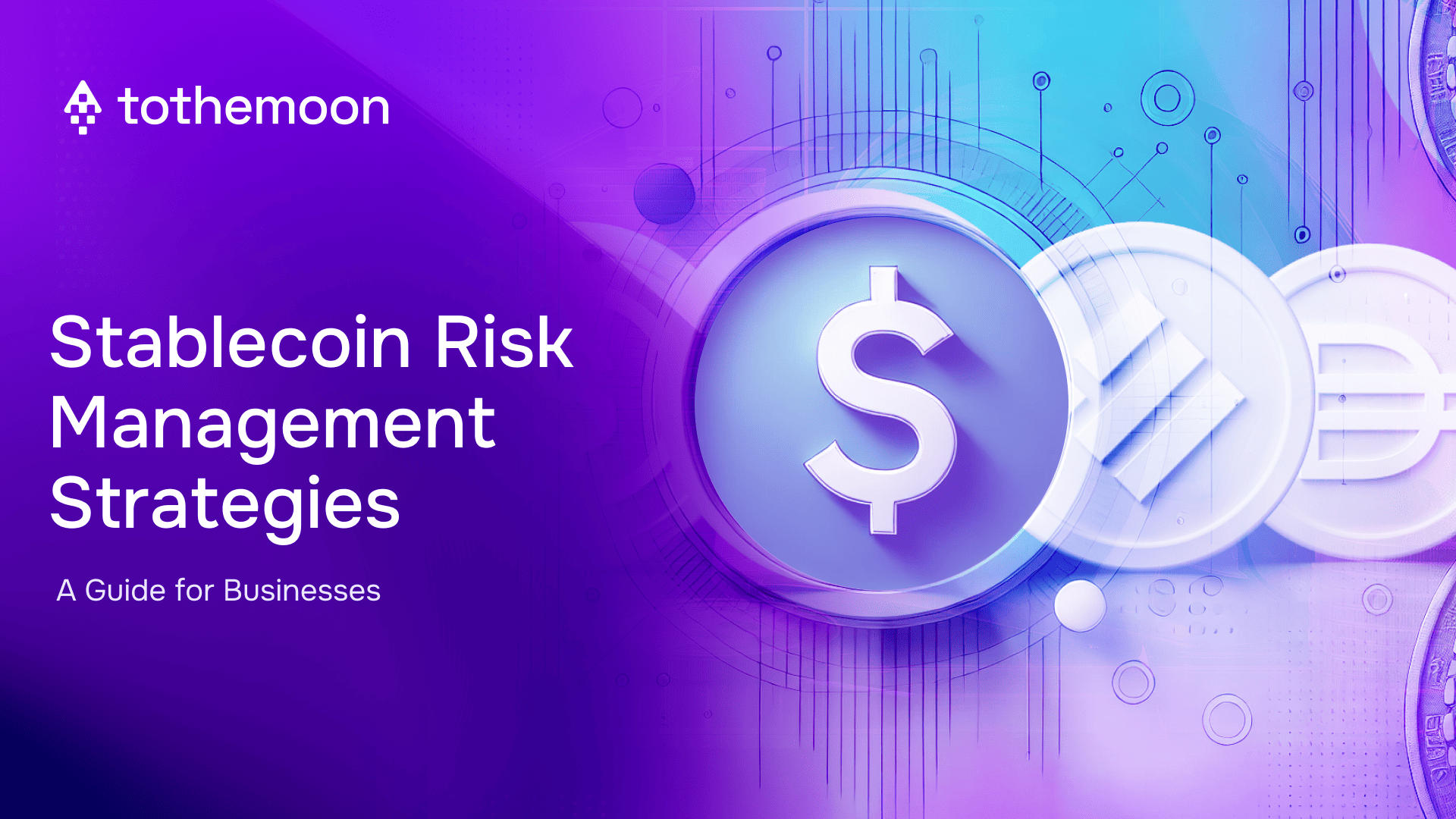
Stablecoin Risk Management Strategies: A Guide for Businesses
Stablecoins now settle trillions of dollars a year, and a growing number of businesses hold them for payments, payouts, and treasury. A dollar-pegged token moves across borders in minutes at a fraction of the cost of a wire. However, a stablecoin is only as sound as the reserves behind it, the code that runs it, and the controls a business puts around it.
This guide explains the main types of stablecoin risk, how reserve structure shapes that risk, and the strategies businesses use to manage their exposure.
In this article
- What is stablecoin risk management?
- The main types of stablecoin risk
- How reserve structure affects risk
- Stablecoin risk management strategies
- How to build a stablecoin risk framework
- Frequently asked questions
What Is Stablecoin Risk Management?
Stablecoin risk management is the set of practices a business uses to hold, send, and receive stablecoins without exposing itself to avoidable loss. It covers the choice of which stablecoins to use, how reserves are checked, how funds are secured, and what happens if a token loses its peg.
The Main Types of Stablecoin Risk
Stablecoin exposure comes from several distinct sources, and each calls for a different control.
Peg and Reserve Risk
A fiat-backed stablecoin holds its value because the market trusts that each token can be redeemed for a dollar. If reserves are insufficient, poorly disclosed, or held in illiquid assets, that trust can weaken and the token can fall below its peg. The brief de-peg of USDC during the Silicon Valley Bank stress in March 2023 showed how quickly a banking issue can move a stablecoin off $1.
Liquidity and Redemption Risk
Reserves only help if they can be converted to cash at scale. When reserves include assets that are hard to sell quickly, an issuer may slow or pause redemptions during market stress, which is exactly when holders want to exit. A business holding a large balance needs to know how fast it could realistically redeem.
Smart Contract and Technical Risk
Most stablecoins run on smart contracts, and a flaw in that code can freeze funds or allow unintended minting. Stablecoins that move across chains also depend on bridges, which have been among the largest targets in crypto hacks. A bridge exploit can leave tokens on one chain unbacked while collateral on another is drained.
Counterparty and Custody Risk
Holding stablecoins means trusting the issuer that manages the reserves and the custodian that holds the keys. A compromised key or a failed counterparty can lead to permanent loss, since blockchain transfers cannot be reversed once confirmed.
Regulatory Risk
Rules for stablecoins differ by country and continue to develop. New requirements can change how a business onboards customers, reports activity, or which stablecoins it can use in a given market. A business operating across borders has to track this corridor by corridor.
How Reserve Structure Affects Stablecoin Risk
The way a stablecoin is backed largely determines its risk profile.
Fiat-Backed Reserves
Backed one-to-one by cash and short-term assets held by an issuer. These carry the lowest peg risk when reserves are high quality and clearly disclosed, but they depend on the issuer's banking partners and reporting.
Crypto-Collateralised Reserves
Backed by other cryptocurrencies locked in a smart contract, with extra collateral posted to absorb price swings. These remove reliance on a single issuer but add exposure to crypto market volatility and liquidation mechanics.
Algorithmic Models
Backed by supply rules rather than assets. These have proven the most fragile, as the collapse of TerraUSD in 2022 demonstrated. Most businesses avoid them for any material balance.
The practical takeaway is to know exactly what backs every stablecoin a business holds, and to favour well-established, fully reserved tokens with regular, credible attestations.
Stablecoin Risk Management Strategies
A practical risk program combines a handful of strategies, each aimed at a specific exposure.
Diversify Across Stablecoins
Holding more than one stablecoin reduces the impact if any single one de-pegs. Concentration in one token is one of the most avoidable exposures a treasury can carry.
Monitor Pegs and Liquidity in Real Time
Watch the price, trading volume, and market depth of every stablecoin held. A peg drifting from $1 or thinning liquidity is often an early warning that allows a business to reduce exposure before a larger move.
Vet Issuers and Reserves
Review who issues each stablecoin, what backs it, how often reserves are attested, and by whom. Treat issuer risk the same way a treasury team treats the risk of a money market fund.
Secure Custody and Key Management
Apply the controls used for cash: multi-signature or MPC wallets, role separation between who initiates and who approves transfers, address allowlists, and an insured custodian for material balances. Most stablecoin losses trace back to compromised keys rather than broken pegs.
Build Compliance Into Operations
Direct business payments need sound AML and KYC processes. Knowing the counterparty, monitoring transactions, and reporting suspicious activity are baseline requirements, not optional extras, for any business moving stablecoins at scale.
Prepare a De-Peg Contingency Plan
Define in advance what triggers action, where alternative liquidity will come from, and who communicates with stakeholders. A plan written during a crisis is always worse than one prepared before it.
How to Build a Stablecoin Risk Framework
A framework turns these strategies into a repeatable process. A practical baseline:
- Map the exposure. List every stablecoin held, its issuer, its backing, and the balance in each.
- Set limits. Cap concentration in any single stablecoin and define transaction and daily limits that require approval.
- Assign controls. Match each risk type to a specific control, from custody to monitoring to compliance.
- Choose partners carefully. Work with regulated providers that maintain institutional-grade custody, clear liability terms, and credible reserve reporting.
- Monitor continuously. Track pegs, liquidity, and wallet activity, and set alerts for anomalies.
- Review on a schedule. Reassess the framework as balances, partners, and regulations change.
Frequently Asked Questions
What is the biggest risk with stablecoins?
For most businesses, it is peg and reserve risk: the chance that a stablecoin falls below its $1 value because its reserves are insufficient or illiquid. Custody and key security are a close second, since lost keys mean permanent loss.
Are stablecoins safe to hold for a business?
Well-established, fully reserved stablecoins are widely used for payments and treasury, but they are not risk-free. The safety depends on the issuer, the reserves, and the controls the business puts around custody and operations.
How can a business protect against a stablecoin de-peg?
Diversify across more than one stablecoin, monitor pegs and liquidity in real time, hold well-reserved tokens, and prepare a contingency plan that defines when and how to reduce exposure.
Which stablecoins are the lowest risk?
Large, fully fiat-backed stablecoins with regular, credible reserve attestations generally carry the lowest peg risk. Algorithmic stablecoins carry the highest.
Explore Tothemoon Solutions
Tothemoon operates across the layers that matter most for both users and businesses. The exchange supports spot and perpetual futures trading across 350+ cryptocurrencies with both centralized matching for deep liquidity and non-custodial staking for users who want to keep their own keys.
For institutional users, mass payouts distribute stablecoin payments across Ethereum, Tron, Solana, and major Layer 2 networks in a single batch. For affiliate and partner programs, the program pays 70% lifetime commission with daily payouts and no minimum threshold.

Risk Disclosure Statement
.jpeg)


.svg)
.svg)
.svg)