.svg)
What is the difference between Layer 1 vs Layer 2 blockchains - scaling the technology to new heights
Layer 1 vs Layer 2 Blockchains: What’s the Difference?
Blockchain scalability is one of the biggest challenges in crypto. As more people use blockchain networks for trading, payments, DeFi, and other applications, networks need to process more transactions without becoming too slow or expensive.
This is where Layer 1 and Layer 2 blockchains come in.
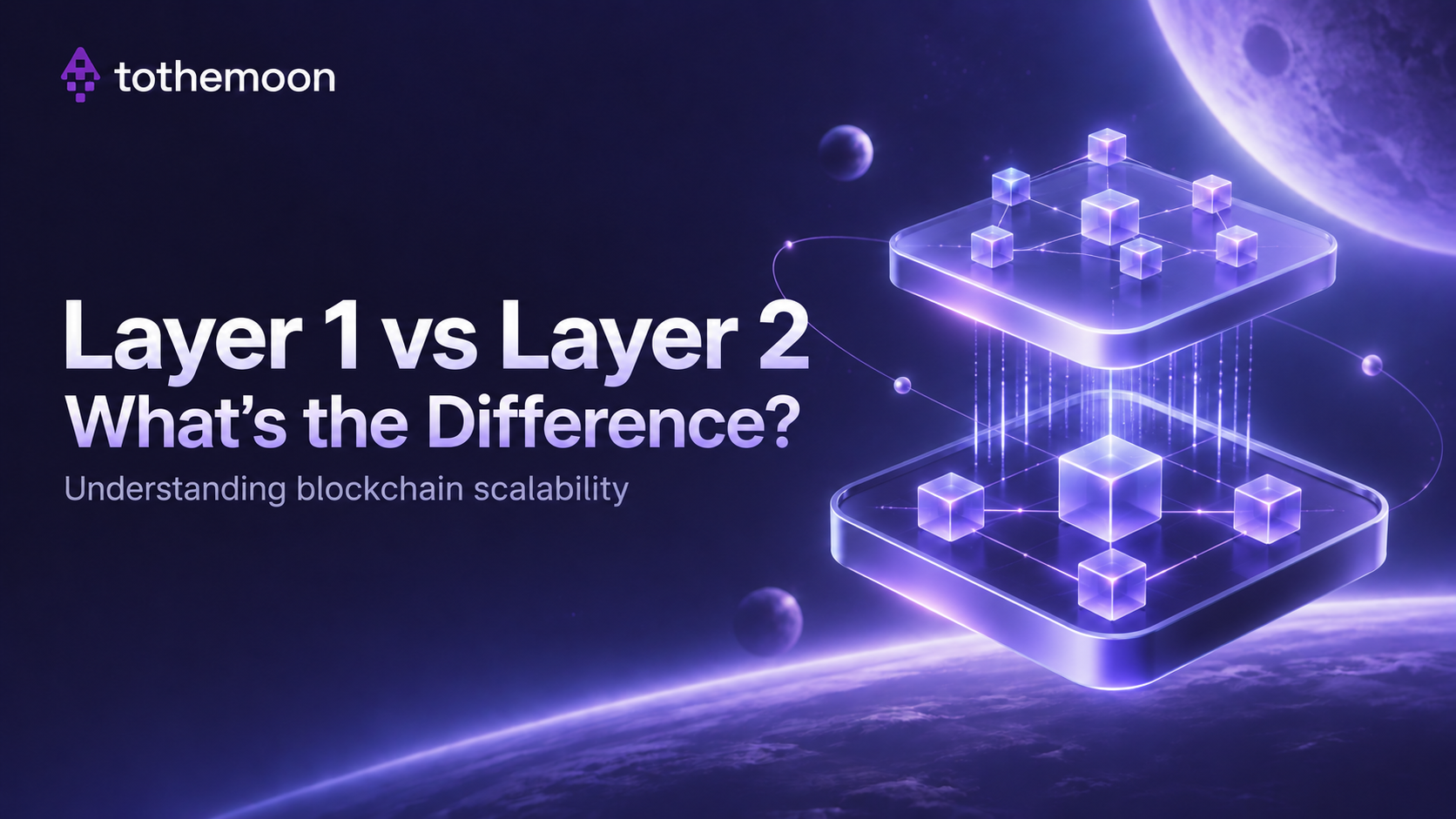
Layer 1 is the base blockchain responsible for consensus, security, and settlement. Layer 2 is additional infrastructure built on top of it to increase transaction capacity and reduce costs.
Let’s look at how they work and what makes Layer 1 and Layer 2 different.
What Is Blockchain Scalability?
Blockchain scalability describes a network’s ability to handle increasing transaction activity while maintaining reasonable speed, costs, security, and decentralization.
When demand exceeds network capacity, users may experience:
- Higher transaction fees
- Slower confirmations
- Network congestion
- Poorer user experience
This challenge is often explained through the blockchain trilemma: balancing scalability, security, and decentralization at the same time.
For a broader overview of how blockchains, wallets, exchanges, and protocols interact, read our guide to the crypto ecosystem.
What Is a Layer 1 Blockchain?
A Layer 1 blockchain, or L1, is the underlying blockchain network.
It has its own consensus mechanism, validators or miners, native cryptocurrency, transaction rules, and security model.
Popular Layer 1 networks include:
- Bitcoin
- Ethereum
- Solana
- Avalanche
- BNB Chain
Each takes a different approach to scalability.
Bitcoin, for example, prioritizes security and decentralization, while Solana is designed to process a larger amount of activity directly at the base layer.
Ethereum combines a Layer 1 blockchain with an increasingly important ecosystem of Layer 2 networks.
You can explore more examples in our list of Layer 1 blockchains.
How Can Layer 1 Blockchains Scale?
Layer 1 networks can increase capacity by changing the underlying protocol.
This can include:
- Increasing block or data capacity
- Improving transaction execution
- Optimizing consensus mechanisms
- Improving how blockchain data is distributed and verified
However, increasing Layer 1 performance can involve trade-offs.
For example, requiring more powerful hardware to operate a blockchain node can improve network performance but may also make it harder for individuals to participate.
This is one reason Layer 2 scaling has become important.
What Is a Layer 2 Blockchain?
A Layer 2, or L2, is a network or protocol built on top of a Layer 1 blockchain to process transactions more efficiently.
Instead of requiring every transaction to be executed directly on Layer 1, Layer 2 networks can process activity separately and then send transaction data or proofs back to the base blockchain.
The goal is to provide:
Higher capacity + lower transaction costs while continuing to use Layer 1 for settlement or security.
Well-known Ethereum Layer 2 networks include:
- Arbitrum
- Optimism
- Base
- zkSync
- Starknet
Ethereum’s current scaling approach relies heavily on Layer 2 rollups rather than trying to execute all user activity directly on Ethereum itself.
What Are Rollups?
Rollups are one of the main technologies used by Ethereum Layer 2 networks.
They process many transactions outside the Layer 1 execution environment and then submit information about them back to Ethereum.
There are two main types.
Optimistic Rollups
Optimistic rollups assume transactions are valid unless someone successfully challenges them.
Examples include Arbitrum, Optimism, and Base.
They can significantly reduce transaction costs, although native withdrawals to Ethereum may take longer because of the challenge mechanism.
ZK-Rollups
Zero-knowledge or ZK-rollups use cryptographic proofs to demonstrate that transactions were processed correctly.
Networks using zero-knowledge technology include zkSync and Starknet.
Both models aim to process more transactions without requiring Ethereum itself to execute every individual transaction.
What About Bitcoin Layer 2?
Layer 2 technology is not limited to Ethereum.
The Lightning Network is a second-layer payment network built around Bitcoin.
Instead of recording every payment directly on Bitcoin, users can make multiple transactions through payment channels and settle the final result on the Bitcoin blockchain.
This makes Lightning particularly useful for faster, lower-cost Bitcoin payments.
Read more in our guide to the Lightning Network and Lightning Addresses.
Layer 1 vs Layer 2: Key Differences
Layer 1Layer 2PurposeBase blockchainScaling infrastructureConsensusOwn consensus mechanismUsually relies partly on the underlying L1TransactionsProcessed by the base networkPrimarily processed outside L1 executionCostsCan rise during congestionUsually lowerCapacityLimited by base-layer resourcesDesigned for greater transaction volumeExamplesBitcoin, Ethereum, SolanaArbitrum, Optimism, Base, Lightning
Layer 1 and Layer 2 are therefore not necessarily competitors. They perform different parts of the same infrastructure.
Benefits of Layer 2 Networks
Lower Transaction Costs
Layer 2 networks can combine many transactions before publishing information to Layer 1, spreading the underlying blockchain cost across multiple users.
Higher Capacity
Processing activity away from the base execution layer allows blockchain ecosystems to support substantially more transactions.
Better User Experience
Lower fees and faster transactions can make blockchain applications more practical for:
- Trading
- Payments
- Gaming
- DeFi
- Digital marketplaces
This is particularly relevant for decentralized finance, where users frequently interact with multiple smart contracts. Learn more in our complete guide to DeFi.
Risks of Layer 2 Networks
Layer 2 networks improve scalability, but they also introduce additional considerations.
Bridge Risk
Moving assets between networks often requires bridges or smart contracts, creating additional technical and security risks.
Sequencer Centralization
Many rollups use sequencers to order transactions. Some of this infrastructure can still be relatively centralized.
Withdrawal Times
Native withdrawals from some optimistic rollups to Ethereum may take longer because of their challenge periods.
Liquidity Fragmentation
The same asset can exist across Ethereum, Arbitrum, Base, Optimism, and other networks, spreading liquidity across multiple ecosystems.
Smart Contract Risk
Layer 2 networks depend on complex smart contracts and upgrade mechanisms.
Understanding how smart contracts work can help users better understand some of these risks.
Are Sidechains the Same as Layer 2?
Not always.
A Layer 2 generally relies on the underlying Layer 1 for important elements of settlement or security.
A sidechain may instead use its own validators and consensus mechanism.
Polygon is a useful example.
Polygon PoS has traditionally used its own validator and security model and is therefore more accurately described as a sidechain rather than an Ethereum rollup.
Other technologies within the Polygon ecosystem use different architectures, including zero-knowledge scaling solutions.
This is why it is better to look at the technology behind a network rather than relying only on the Layer 1 or Layer 2 label.
Layer 1 or Layer 2: Which Is Better?
Neither is inherently better — they serve different purposes.
Layer 1 provides the foundation: consensus, security, settlement, and blockchain infrastructure.
Layer 2 expands the foundation: increasing transaction capacity and reducing costs.
A user might hold ETH secured by Ethereum, move it to Base or Arbitrum, interact with an application there at lower cost, and later settle assets back to Ethereum.
This creates a multi-layer blockchain ecosystem where different networks handle different functions.
The Future of Blockchain Scaling
Blockchain scaling is increasingly about specialization rather than asking one blockchain to do everything.
Layer 1 networks can focus on security, consensus, settlement, and data availability, while Layer 2 networks handle greater amounts of transaction execution.
Other ecosystems, such as Solana, continue to pursue greater scalability primarily at the Layer 1 level.
As blockchain infrastructure develops, these different approaches are likely to coexist.
Understanding the difference between Layer 1 and Layer 2 can help users better evaluate transaction fees, network performance, security assumptions, and the applications they choose to use.
FAQ
What is the main difference between Layer 1 and Layer 2?
Layer 1 is the base blockchain with its own consensus and security system. Layer 2 is infrastructure built on top of a Layer 1 to increase capacity and reduce transaction costs.
Is Ethereum Layer 1 or Layer 2?
Ethereum is a Layer 1 blockchain. Arbitrum, Optimism, Base, zkSync, and Starknet are examples of Ethereum Layer 2 networks.
Is Bitcoin a Layer 1 blockchain?
Yes. Bitcoin is Layer 1, while the Lightning Network operates as a second-layer payment network built around Bitcoin.
Is Solana Layer 1 or Layer 2?
Solana is a Layer 1 blockchain designed to process high transaction volumes primarily through its base-layer architecture.
Are Layer 2 transactions cheaper?
Generally, yes. Layer 2 networks are designed to reduce the cost of transactions compared with performing equivalent activity directly on Layer 1, although actual fees vary by network and demand.
Conclusion
Layer 1 and Layer 2 networks solve different parts of the blockchain scalability problem.
Layer 1 provides security, consensus, and settlement. Layer 2 helps increase capacity and reduce transaction costs.
Rather than replacing one another, the two can work together to create blockchain ecosystems capable of supporting more users and applications.
Learn more about how Tothemoon can help you buy, trade, and manage crypto and explore more educational guides and insights on the Tothemoon Blog.

Risk Disclosure Statement
.jpeg)


.svg)
.svg)
.svg)