.svg)
Conditional Payments with Smart Contracts: How They Work
Conditional payments are payments that happen only when specific conditions are met. A business may want to release funds after delivery, pay a contractor after a milestone, split revenue after a sale, or return funds if an event does not occur. Smart contracts can help automate some of these payment conditions on blockchain networks.
For businesses, conditional payments can reduce manual payment steps and make settlement rules more consistent. They can also create new risks if the conditions are poorly defined, the data source is unreliable, or the contract cannot handle exceptions.
This article explains how conditional payments with smart contracts work and what businesses should understand before using them.
What Is a Conditional Payment?
A conditional payment is a payment that depends on a rule. The rule might be simple, such as "release funds after a specific date." It might also be more complex, such as "release payment when a delivery status changes, two parties approve, and the recipient wallet passes checks."
In traditional finance, conditional payments can be handled through contracts, invoices, escrow arrangements, banking instructions, or platform rules. In blockchain-based systems, some conditions can be encoded into smart contracts so that payment execution happens automatically once the required state is reached.
When stablecoins are used, the payment can be denominated in a digital asset designed to track a fiat currency. This can make conditional stablecoin payments easier to price and reconcile than payments made with volatile assets.
How Conditional Payments Work with Smart Contracts
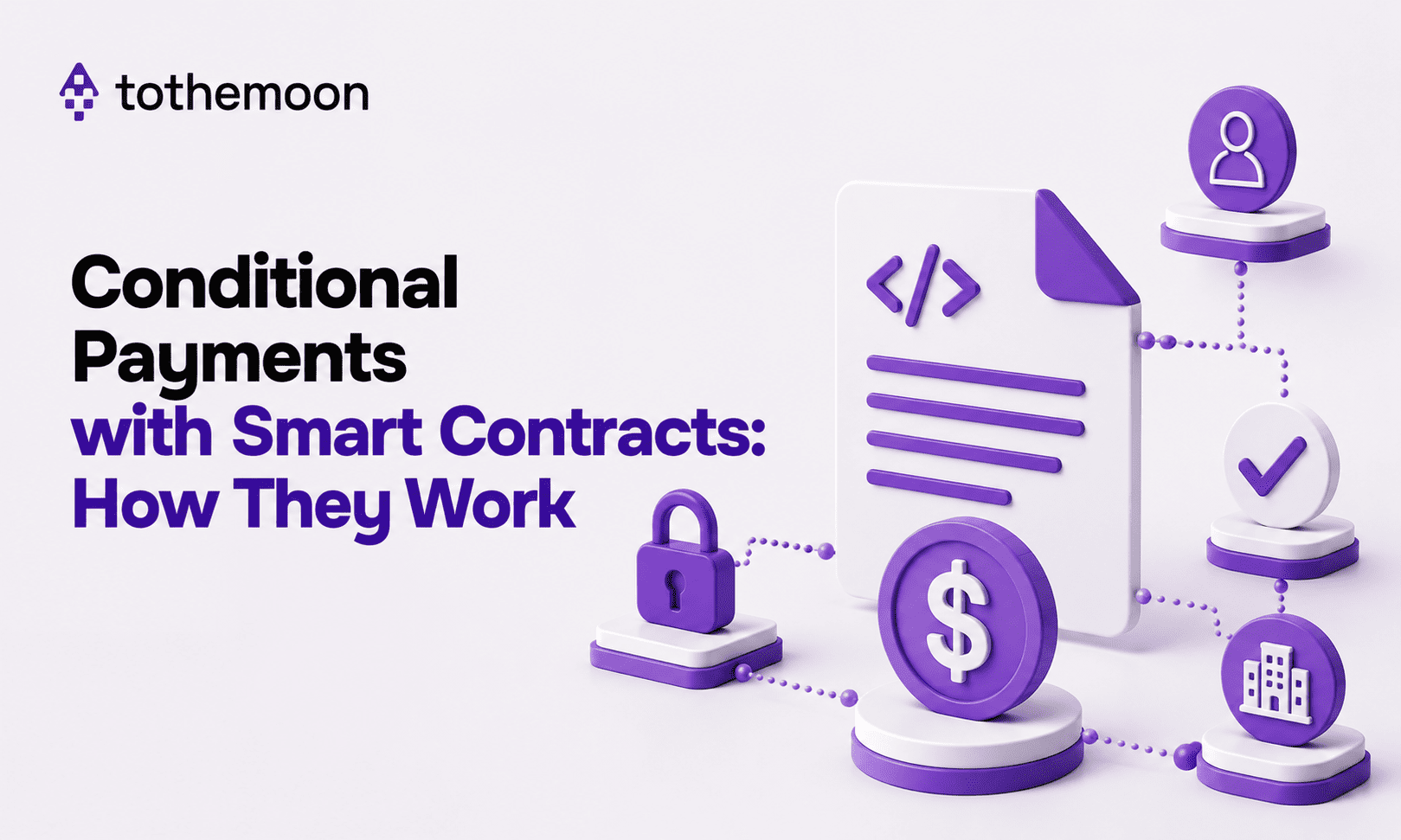
A conditional smart contract payment usually has four parts: funds, conditions, execution logic, and settlement.
Funds Are Committed
The payer, platform, or business sends funds to a wallet or contract-controlled address. The funds may be held until the condition is met. In some designs, the payer authorizes a future transfer rather than depositing funds immediately.
For business use, the funding model should be clear. Finance teams need to know when funds leave the payer, when they become available to the recipient, and how balances are recorded while the condition is pending.
Conditions Are Defined
The contract needs a condition it can evaluate. Conditions may be based on time, signatures, delivery status, transaction confirmation, account balance, milestone approval, or external data.
The stronger the condition, the more reliable the payment flow. A condition based on ambiguous manual judgment may need human approval before the contract can execute. A condition based on unreliable external data can trigger the wrong result.
The Contract Executes the Rule
When the condition is met, the smart contract executes the programmed action. It may release funds, split payment between recipients, return funds to the payer, or change the payment status.
Because on-chain transactions are often difficult to reverse, the rule should be tested carefully before real funds move through the system.
Settlement Is Recorded
After execution, the transaction is recorded on the blockchain network. The business can verify the transaction through a blockchain explorer, but internal records still need to connect the transaction to the order, invoice, customer, vendor, fee, or payout.
Settlement visibility helps only when the business can reconcile it.
Common Business Use Cases
Conditional payments are useful when the business wants to reduce manual handling while keeping payment tied to a defined event.
Milestone Payments
Contractors, vendors, and service providers can be paid after a milestone is approved. The smart contract can hold funds until the business confirms the milestone or until another agreed condition is met.
This can reduce payment delays, but the approval process still needs to be clear. The contract cannot judge work quality unless the business gives it a reliable signal.
Marketplace Settlement
Marketplaces may use conditional payment logic to hold funds until an order is fulfilled, a return period expires, or a seller meets platform rules. Revenue can then be split between the seller, platform, and other participants.
This requires careful exception handling. Canceled orders, disputes, failed deliveries, and wrong recipient details should be covered before launch.
Subscription and Usage-Based Billing
Conditional logic can support recurring or usage-based payments, especially in digital services. A payment may execute when a billing period ends, when usage reaches a threshold, or when an account balance needs to be topped up.
Businesses should still define customer communication, failed payment handling, refund rules, and access changes.
Global Payouts
Conditional payouts can help platforms send funds only after recipient checks, wallet validation, or transaction approvals are complete. This is relevant for affiliate programs, contractor payments, and creator platforms.
If the payout uses stablecoins, the business should also review liquidity, network support, compliance checks, and recipient off-ramp options.
Benefits for Businesses
Conditional payments can improve consistency and reduce manual processing when rules are clear.
They can make settlement faster once a condition is met, reduce repetitive back-office work, create a transparent transaction record, and support multi-party payment flows. They can also help teams design payment logic that is the same for every participant instead of relying on ad hoc manual decisions.
For businesses using blockchain payment solutions, conditional payments can be useful when funds need to move across borders or outside traditional banking hours.
Risks and Controls
Conditional payments need controls because automated execution can move funds before humans notice a mistake.
Ambiguous Conditions
If the condition is unclear, the payment flow can create disputes. Businesses should define exactly what triggers payment, who can approve completion, and what evidence is required.
Data Source Risk
Some conditions depend on external data or system status. If the data source fails or is manipulated, the contract may execute incorrectly. Businesses should know which systems feed the contract and what happens if data is missing.
Code and Audit Risk
Smart contract code should be reviewed and tested before it handles meaningful value. Audits, test transactions, staged rollouts, and limits can reduce the chance of a serious failure.
Wallet and Permission Risk
Conditional payment contracts may require admin permissions, signer approvals, or operational wallets. Crypto security should cover who can pause the flow, change conditions, approve recipients, and move funds.
Compliance and Refund Rules
Businesses still need compliance checks, sanctions screening, transaction records, and refund procedures. A conditional payment may be automated, but the company remains responsible for how the payment is offered and recorded.
When Conditional Payments Make Sense
Conditional payments make sense when the payment event can be defined clearly and verified reliably. They work best for repeatable flows, such as marketplace settlement, milestone releases, stablecoin payouts, escrow-like deposits, and usage-based billing.
They are less suitable when conditions are subjective, disputes are frequent, or legal obligations require manual review before funds move.
Conclusion
Conditional payments with smart contracts let businesses tie payment execution to defined events. They can support milestone releases, marketplace settlement, revenue splits, subscriptions, and global stablecoin payouts.
The useful version is not just "automatic payment." It is a payment flow where the condition is clear, the code is reviewed, the data source is trusted, wallet permissions are controlled, and exception handling is already planned. That is what makes conditional payments usable for real business operations.
Explore Tothemoon Solutions
Tothemoon is an all-in-one crypto platform built for both institutional and retail users. For our institutional clients, we offer on-ramp and off-ramp solutions, advanced trading and OTC desk services, crypto processing, mass payouts, API integration, staking, and dedicated concierge support. Our product suite for retail clients offers spot trading, futures, staking, and a versatile crypto card for everyday spending. Tothemoon bridges accessibility with professional-grade tools, making crypto practical and efficient for all.

Risk Disclosure Statement
.jpeg)


.svg)
.svg)
.svg)