.svg)
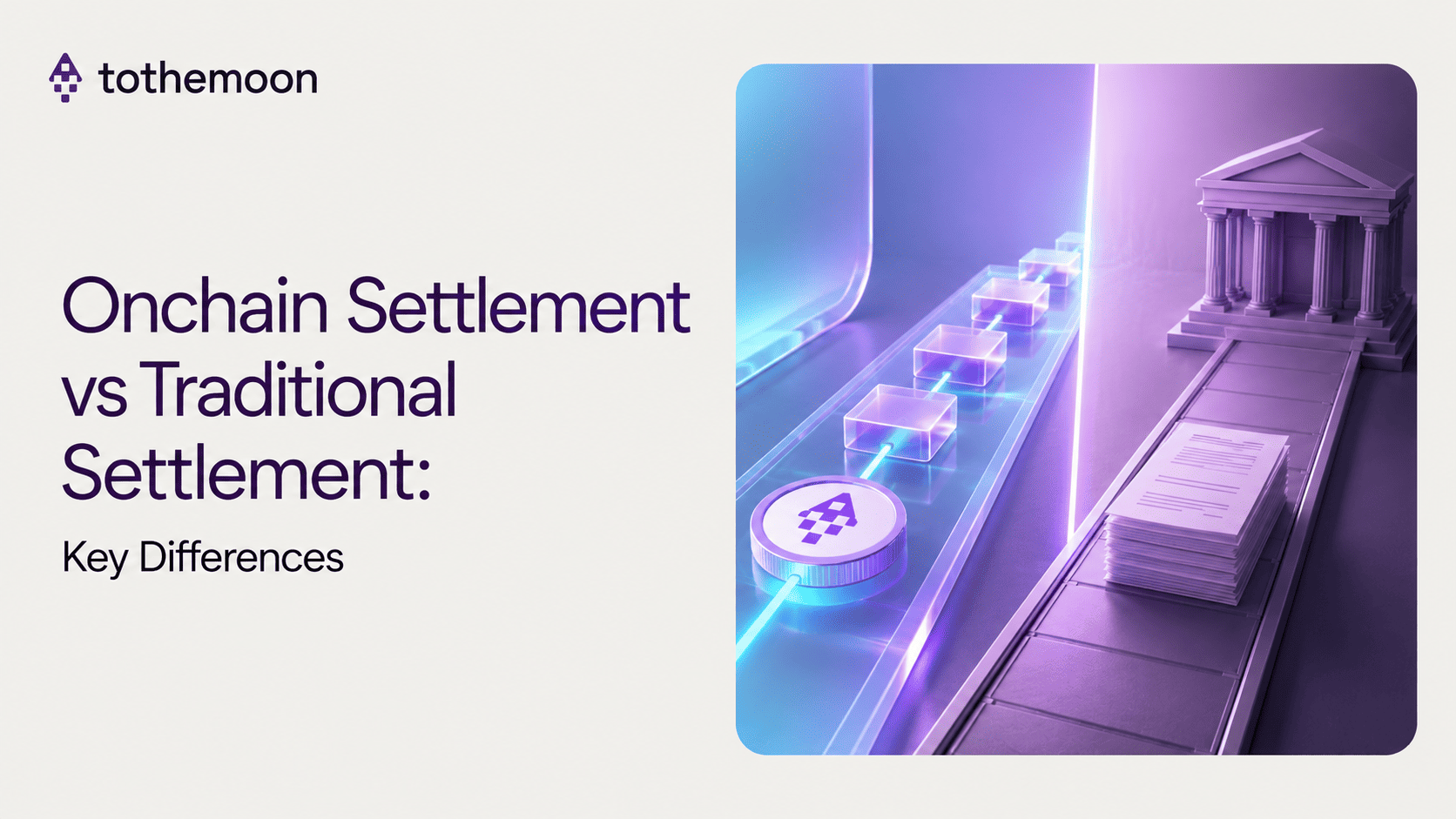
Onchain Settlement vs Traditional Settlement: Key Differences
Settlement is the point where a payment becomes more than an instruction. Value has moved, records have changed, and the receiver can treat the funds as available under the rules of that payment system. In traditional finance, settlement often depends on banks, processors, clearing systems, card networks, and local operating hours. In crypto, settlement can happen directly on a blockchain network.
For businesses, the difference matters. Settlement affects cash flow, refunds, reconciliation, risk exposure, fraud controls, support workflows, and how quickly funds can be reused. On-chain settlement does not simply mean "faster payments." It means the payment is recorded and finalized through a different infrastructure model.
This article explains the key differences between onchain settlement and traditional settlement for business payments.
What Is Traditional Settlement?
Traditional settlement is the process of completing a payment through banks, card networks, payment processors, clearing houses, or account-based financial systems. The customer may see a payment as successful immediately, but the merchant may not receive final funds until later.
Card payments are a common example. A customer pays online, the authorization appears instantly, and the merchant can proceed with the order. Behind the scenes, the transaction still moves through clearing and settlement. Fees, chargebacks, reversals, reserves, and batch timing can affect when the merchant actually receives usable funds.
Bank transfers work differently, but they also depend on banking rails, cut-off times, holidays, correspondent banks, and local settlement systems. Cross-border payments can involve several intermediaries before the receiver gets final value.
What Is Onchain Settlement?
Onchain settlement happens when a transaction is recorded on a blockchain network and reaches the level of confirmation required by the receiver. The transaction is visible on the ledger, and the recipient wallet balance changes according to the network rules.
In business payments, onchain settlement can involve stablecoins, cryptocurrencies, tokenized assets, or other digital tokens. The sender transfers funds from one wallet to another, and the network validates the transaction without relying on the same clearing structure used by banks or card networks.
A blockchain explorer can show the transaction hash, wallet addresses, network status, timestamp, and confirmations. This transparency can help finance and operations teams verify whether funds moved, although internal reconciliation is still needed.
Speed and Availability
Traditional settlement speed depends on the payment method. Card authorization can feel instant, but merchant settlement may take days. Domestic bank transfers may settle quickly in some countries and slowly in others. Cross-border payments can take longer because intermediaries, time zones, cut-off windows, and compliance reviews add friction.
Onchain settlement can occur much faster, depending on the blockchain network, congestion, fee settings, and confirmation requirements. Some networks settle in seconds or minutes, while others take longer. The important difference is availability: blockchain networks generally operate continuously, including nights, weekends, and holidays.
For a business operating across time zones, continuous settlement can improve liquidity. Funds do not have to wait for local banking hours before they can be moved, converted, or used for payouts.
Intermediaries and Control
Traditional settlement usually depends on several intermediaries. A card payment may involve the merchant acquirer, issuing bank, card network, processor, gateway, and settlement bank. A cross-border wire may involve correspondent banks and local receiving banks.
Onchain settlement reduces some of those intermediaries at the transfer layer. A wallet can send value directly to another wallet on a blockchain network. That does not mean every intermediary disappears. Businesses may still use exchanges, custodians, payment processors, compliance tools, or fiat off-ramp providers.
The practical difference is where control sits. With traditional settlement, payment completion depends heavily on account-based institutions. With onchain settlement, the transfer can be verified through the network, while providers handle custody, conversion, compliance, and reporting around it.
Transparency and Traceability
Traditional payment systems usually give businesses limited visibility into the underlying settlement path. A merchant may see processor reports, bank statements, payout batches, and dispute notices, but it cannot always inspect every step between payer and receiver.
Onchain settlement creates a visible transaction record. Wallet addresses, transaction hashes, timestamps, token amounts, and confirmation status can often be viewed publicly. This can make it easier to verify whether a payment was sent, when it arrived, and which address received it.
Visibility also creates responsibility. Businesses need to interpret transaction data correctly and connect it to customers, orders, invoices, or payouts. Blockchain payment solutions often include reporting tools because a ledger record alone is not enough for finance operations.
Finality and Reversibility
Traditional payments often include reversal mechanisms. Card payments can be charged back. Bank transfers may be recalled in some cases. Payment processors can hold funds, reverse transactions, or adjust merchant balances. These mechanisms can protect customers, but they also create risk and uncertainty for merchants.
Onchain settlement is usually harder to reverse after confirmation. If funds are sent to the wrong address, sent on the wrong network, or sent as part of a scam, recovery may be difficult or impossible without the cooperation of the recipient.
For businesses, this changes the risk model. Onchain settlement can reduce chargeback-style uncertainty, but it requires stronger controls before the transaction is sent or accepted. Wallet validation, confirmation thresholds, fraud screening, and clear refund procedures become more important.
Cost Structure
Traditional settlement costs can include card processing fees, cross-border fees, FX spreads, chargeback fees, bank transfer fees, account fees, and intermediary costs. These costs vary by country, payment method, merchant category, and transaction volume.
Onchain settlement costs usually include network fees, provider fees, custody fees, conversion spreads, and compliance tooling. A stablecoin transfer may be cheap on one network and expensive on another during congestion. Provider pricing can also change the total cost.
Businesses should compare full payment cost, not only the visible transaction fee. For onchain settlement, that means adding network fees, conversion cost, reconciliation work, support burden, risk controls, and any fiat off-ramp fees.
Compliance and Risk Controls
Traditional settlement has mature compliance and fraud systems built around banks, processors, card networks, and regulated institutions. That does not make fraud disappear, but it creates established processes for identity checks, disputes, transaction monitoring, and regulatory reporting.
Onchain settlement needs a different control stack. Businesses may need wallet screening, sanctions checks, risk scoring, transaction monitoring, and rules for high-risk addresses or jurisdictions. Crypto fraud prevention is especially important because funds can move quickly and confirmed transactions are difficult to unwind.
Custody is also part of the risk model. If a business controls wallets directly, it must protect private keys and withdrawal permissions. If it relies on a provider, it must understand how that provider secures assets and handles incidents. Crypto security should be treated as part of settlement design, not only an IT concern.
Reconciliation and Reporting
Traditional settlement is usually reported through processor dashboards, bank statements, payout reports, and accounting integrations. These reports may be delayed or grouped into batches, but they are designed around familiar finance workflows.
Onchain settlement gives businesses transaction-level visibility, but the raw data needs structure. A transaction hash does not automatically explain which customer paid, which invoice was settled, what exchange rate applied, which fees were charged, or whether the funds were later converted into fiat.
Businesses using onchain settlement need reporting that connects blockchain activity to internal records. That includes wallet addresses, transaction hashes, tokens, networks, timestamps, order IDs, conversion rates, fees, and final settlement amounts.
When Onchain Settlement Makes Sense
Onchain settlement is most useful when speed, cross-border reach, continuous availability, transparent transaction records, or digital asset movement create a meaningful business advantage. It can be useful for stablecoin checkout, global supplier payments, contractor payouts, marketplace settlement, treasury movement, and crypto-native products.
Traditional settlement remains a better fit when users expect card protections, local bank transfers are already fast and cheap, compliance requirements are easier through existing rails, or the business does not have enough crypto payment demand to justify operational complexity.
Many businesses do not need to choose only one model. They may use traditional settlement for local card payments and onchain settlement for specific cross-border, digital-native, or treasury workflows.
Conclusion
Onchain settlement and traditional settlement solve the same core problem through different infrastructure. Traditional settlement relies on established financial intermediaries, familiar reporting, and reversible payment rules. Onchain settlement uses blockchain networks for direct transfer, continuous availability, visible transaction records, and stronger finality after confirmation.
For businesses, the right choice depends on the payment flow. Onchain settlement can improve speed and global reach, but it requires sharper controls around wallets, monitoring, reconciliation, and customer support. Traditional settlement can be slower and more expensive in some cross-border cases, but it remains familiar, widely adopted, and easier for many customers. The strongest payment setup often uses both where each one fits.
Explore Tothemoon Solutions
Tothemoon is an all-in-one crypto platform built for both institutional and retail users. For our institutional clients, we offer on-ramp and off-ramp solutions, advanced trading and OTC desk services, crypto processing, mass payouts, API integration, staking, and dedicated concierge support. Our product suite for retail clients offers spot trading, futures, staking, and a versatile crypto card for everyday spending. Tothemoon bridges accessibility with professional-grade tools, making crypto practical and efficient for all.

Risk Disclosure Statement
.jpeg)


.svg)
.svg)
.svg)