.svg)
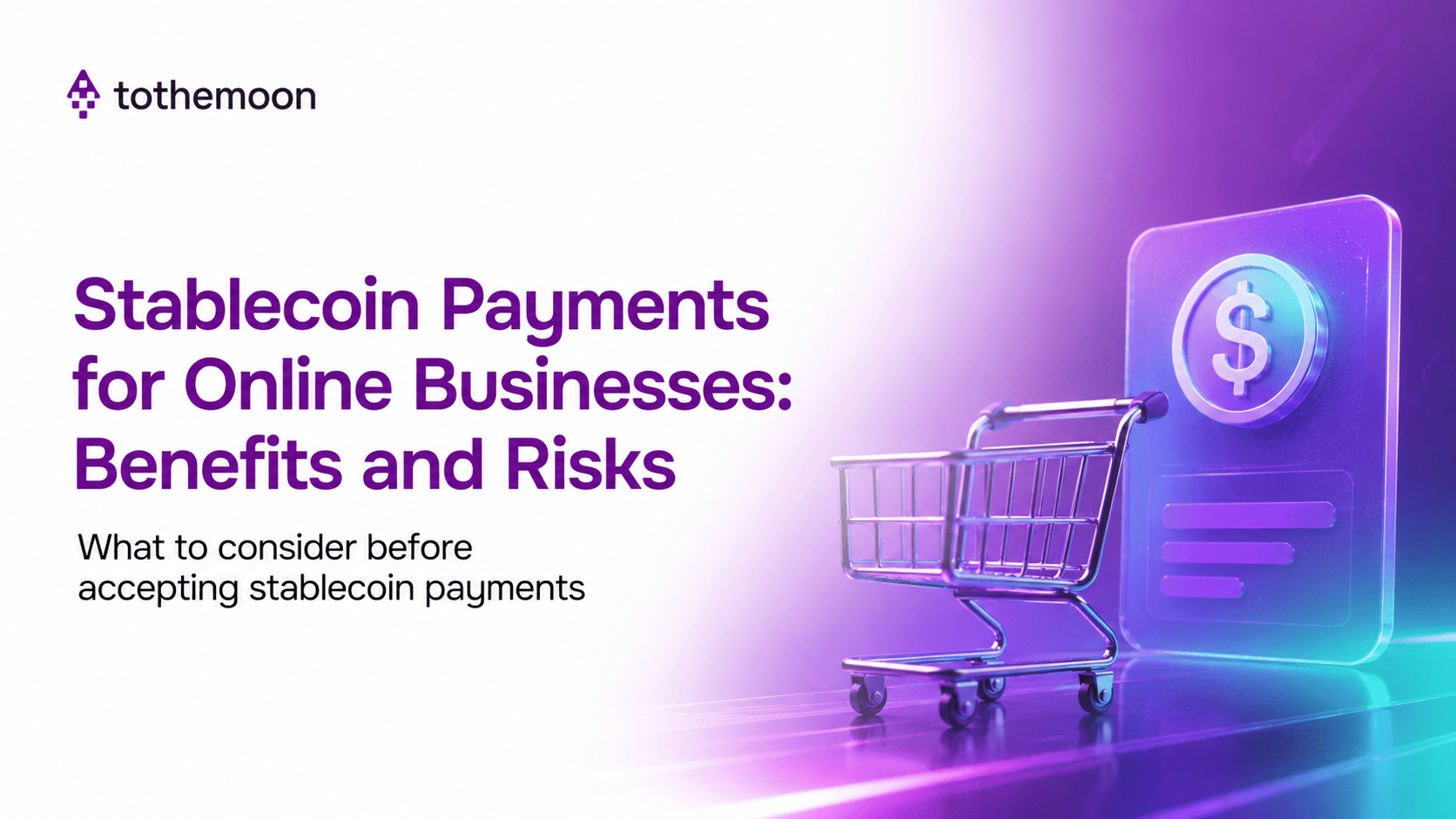
Stablecoin Payments for Online Businesses: Benefits and Risks
Online businesses are under constant pressure to make payments faster, cheaper, and easier to use across markets. Card payments are familiar, but they can be expensive for cross-border sales, vulnerable to chargebacks, and limited by local banking coverage. Bank transfers can work well for invoices, but they are often slow and inconsistent across countries.
Stablecoin payments give online businesses another option. A customer can pay with a digital asset designed to track a fiat currency, and the business can receive the payment through a wallet, payment processor, exchange, or crypto payment platform.
The model can be useful, but it needs careful setup. Stablecoins change how checkout, settlement, fraud monitoring, refunds, custody, and finance reporting work. For online businesses, the decision should be based on payment use case, customer demand, operational readiness, and risk controls.
Why Online Businesses Consider Stablecoin Payments
Stablecoins can help online businesses reach customers who prefer crypto payments or who operate in markets where traditional payment methods are expensive or unreliable. They can also support faster settlement for digital goods, subscriptions, marketplaces, creator platforms, SaaS products, gaming, and cross-border ecommerce.
Because many stablecoins are designed to track fiat value, they can be easier for businesses to price and reconcile than more volatile crypto assets. A company selling a product for 100 dollars can accept an equivalent stablecoin amount without exposing the customer to a constantly changing crypto price at checkout.
Stablecoins do not remove every payment problem. They move the business into a different operating model, where wallet addresses, blockchain networks, confirmations, transaction monitoring, and conversion rules become part of the payment experience.
Benefits for Online Businesses
Stablecoin payments can create real advantages when they match the customer base and business model.
Faster Cross-Border Settlement
Traditional cross-border payments can move through several banks, payment processors, correspondent networks, and local intermediaries. That can add cost and delay, especially outside major currency corridors.
With stablecoins, value can move across blockchain networks in minutes or less, depending on the network and provider setup. For online businesses selling digital products or services globally, faster settlement can improve cash flow and reduce waiting time between payment and fulfillment.
Blockchain payment solutions are especially relevant when the business serves customers, contractors, or partners in multiple regions.
Lower Dependence on Card Rails
Cards are still dominant for ecommerce, but they are not ideal for every transaction. Online businesses may face high processing fees, cross-border surcharges, rolling reserves, failed authorizations, or chargeback exposure.
Stablecoin payments can add another rail alongside cards and bank transfers. This does not mean cards disappear. It means the business can offer an option for customers who already hold crypto assets or prefer digital wallet payments.
Better Fit for Digital-Native Customers
Some online businesses serve customers who already use crypto wallets, exchanges, DeFi platforms, gaming assets, or creator tools. For those users, paying with stablecoins may feel natural.
The strongest fit is usually where the product is also digital: software, subscriptions, online services, gaming, marketplaces, communities, digital content, and international professional services.
Faster Payouts to Sellers or Contractors
Marketplaces, platforms, affiliate programs, and creator businesses often need to send payments to many recipients. Stablecoins can support faster payouts when recipients are comfortable using wallets and the business has proper screening and wallet validation.
This can reduce reliance on slow bank transfers in markets where payout rails are fragmented. The business still needs recipient records, tax reporting processes, sanctions checks, and customer support for failed or delayed transfers.
Risks Online Businesses Need to Manage
Stablecoin payments also introduce risks that are different from card or bank payments. The risks are manageable, but they need to be named clearly before launch.
Network and Address Errors
Stablecoins can exist on multiple blockchain networks. A customer may send the right stablecoin on the wrong network, use an unsupported wallet, underpay because of fees, or send funds after the checkout window expires.
Online businesses should make network selection obvious in the checkout flow. The payment page should show the token, network, amount, expiration time, and address clearly. For higher-risk flows, wallet validation and provider-side detection can reduce support issues.
Limited Reversibility
Card payments can be disputed or reversed through card-network rules. Blockchain transfers are different. Once a stablecoin transaction is confirmed, it is usually difficult to reverse without the cooperation of the receiving party.
This can reduce chargeback exposure for merchants, but it also changes customer support. Refunds, duplicate payments, underpayments, and wrong-network transfers need documented procedures. If the customer experience is unclear, payment support can become expensive quickly.
Depegging and Liquidity Risk
Stablecoins are built to maintain a target value, but they can still lose or temporarily move away from their peg. This matters most when a business holds stablecoin balances instead of converting them quickly.
Online businesses should decide whether to convert stablecoins immediately, hold a limited balance, or use them for outgoing payments. Stablecoin risk management should define exposure limits, approved assets, provider requirements, and actions during market stress.
Fraud, Sanctions, and Suspicious Funds
Crypto payments can be transparent on public ledgers, but online businesses still need transaction monitoring. A payment from a risky wallet, sanctioned address, scam cluster, or hacked source can create compliance and banking problems.
Crypto fraud prevention should cover wallet risk checks, sanctions screening, velocity patterns, high-risk jurisdictions, account takeover signals, and manual review triggers.
Custody and Security
If an online business holds stablecoins directly, it must protect the wallets that control those funds. If it uses a third-party provider, it must understand how the provider handles custody, withdrawals, account security, and incident response.
The choice between custodial and non-custodial wallets affects who controls private keys, who can move funds, how withdrawals are approved, and what happens if credentials are compromised.
Checkout Design for Stablecoin Payments
Online checkout needs to remove ambiguity. A stablecoin checkout page should show the exact amount, token, network, wallet address, QR code, expiration time, and payment status. It should also explain what happens if the customer sends the wrong amount or uses the wrong network.
For digital goods, the business needs a confirmation threshold before delivery. For subscriptions, it needs a way to link recurring access to wallet payments, invoices, or account balances. For marketplaces, the platform needs to connect incoming payments to orders, seller balances, fees, and payout schedules.
The customer should not need to understand the business's back-end payment process. The interface should make the correct action obvious.
Settlement and Reconciliation
Stablecoin settlement can be fast, but finance teams still need accurate records. Every payment should connect to an order ID, customer account, transaction hash, wallet address, network, amount, fee, exchange rate, and conversion record if fiat settlement occurs.
A blockchain explorer can confirm whether a transaction occurred, but it does not replace internal reconciliation. The business still needs reporting that works for accounting, tax, customer support, and audit review.
If the business converts stablecoins into fiat, the finance team should track conversion timing and final settlement amount. If the business holds stablecoins, it should define balance limits and valuation rules.
When Stablecoin Payments Are a Good Fit
Stablecoin payments make the most sense when an online business has customers who already use crypto, sells across borders, handles international payouts, faces high card costs, or needs faster digital settlement.
They may not be worth the added complexity for a purely local business with low card costs, few cross-border customers, and no customer demand for crypto payments. The payment method should solve a real operational or customer problem.
Conclusion
Stablecoin payments can help online businesses serve global customers, settle faster, reduce dependence on card rails, and support digital-native payment habits. They also require new controls for checkout design, wallet security, transaction monitoring, refunds, and reconciliation.
The best setup starts with a narrow use case: one or two approved stablecoins, a small number of supported networks, clear conversion rules, and a provider model that finance and compliance teams can actually operate. From there, the business can expand stablecoin payments without turning checkout into a source of avoidable support and risk.
Explore Tothemoon Solutions
Tothemoon is an all-in-one crypto platform built for both institutional and retail users. For our institutional clients, we offer on-ramp and off-ramp solutions, advanced trading and OTC desk services, crypto processing, mass payouts, API integration, staking, and dedicated concierge support. Our product suite for retail clients offers spot trading, futures, staking, and a versatile crypto card for everyday spending. Tothemoon bridges accessibility with professional-grade tools, making crypto practical and efficient for all.

Risk Disclosure Statement
.jpeg)


.svg)
.svg)
.svg)