.svg)
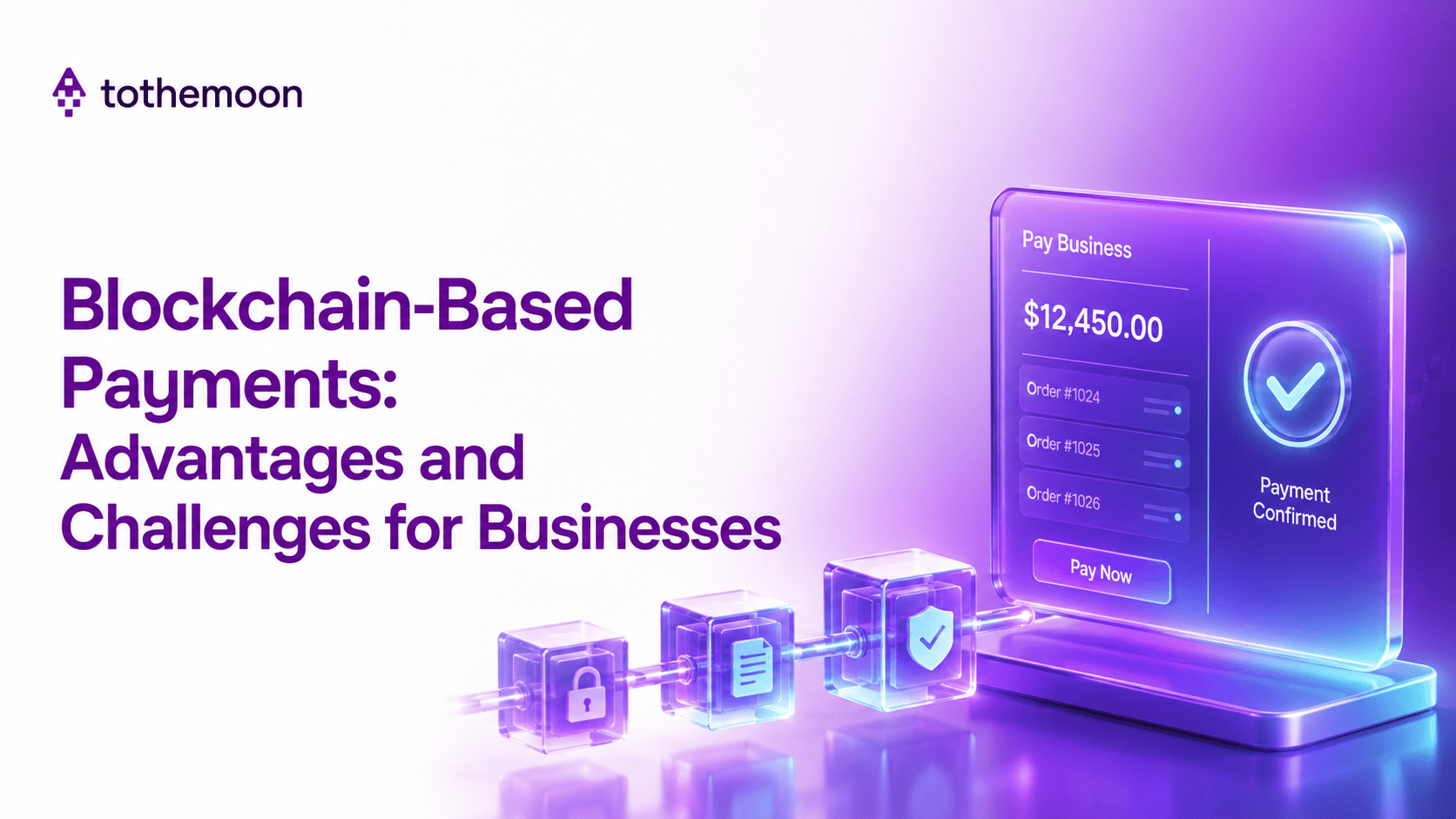
Blockchain-Based Payments: Advantages and Challenges for Businesses
Blockchain-based payments give businesses another way to move value, settle transactions, and serve customers across markets. Instead of relying only on card networks, banks, and clearing systems, a payment can move across a blockchain network from one wallet to another.
For businesses, the appeal is easy to understand: faster settlement, broader geographic reach, programmable payment flows, and more visibility into transaction status. The challenge is just as concrete. Blockchain payments introduce new decisions around wallets, networks, custody, compliance, refunds, transaction monitoring, and finance reporting.
This article explains the main advantages and challenges of blockchain-based payments for businesses, with a focus on practical operating decisions rather than technical theory.
What Are Blockchain-Based Payments?
Blockchain-based payments are payments that use a blockchain network to transfer digital value. The asset can be a cryptocurrency, a stablecoin, or another tokenized form of value. The sender initiates a transaction from a wallet, the network validates it, and the receiver can verify the transaction on the ledger.
In business settings, blockchain payments are often used for checkout, invoices, supplier payments, treasury transfers, marketplace settlement, and global payouts. Many companies prefer stablecoins for these flows because they are designed to track the value of a fiat currency and can be easier to price, reconcile, and explain to customers.
Blockchain payments do not remove the need for providers. A business may still use a payment processor, exchange, custodian, wallet provider, compliance tool, or fiat settlement partner. The difference is that the transfer layer can operate through blockchain infrastructure instead of only through traditional payment rails.
Advantages of Blockchain-Based Payments
Blockchain payments can be useful when they solve a real business problem: slow cross-border settlement, high intermediary cost, limited banking access, fragmented payout rails, or customer demand for crypto payment options.
Faster Settlement Across Borders
Traditional cross-border payments can pass through multiple banks, processors, and local intermediaries. Each step can add time, fees, and operational uncertainty. A blockchain payment can move value directly across a network, often with faster confirmation than international bank transfers.
For businesses working with international customers, contractors, suppliers, or subsidiaries, faster settlement can improve liquidity planning. Funds can be received, converted, or reused without waiting for several banking days in every market.
This is one reason blockchain payment solutions are often discussed in the context of global commerce rather than only crypto-native products.
Continuous Network Availability
Many traditional payment systems still depend on banking hours, local holidays, batch processing, or cut-off times. Blockchain networks generally operate continuously. That can be useful for businesses that serve customers across time zones or need to settle digital transactions outside local banking hours.
Continuous availability does not mean every provider operates instantly at all times. Exchanges, custodians, compliance teams, and fiat off-ramp partners may still have review processes or operational limits. But the network layer itself is not tied to the same schedule as many traditional systems.
Transaction Transparency
On public blockchains, transactions can often be verified through a blockchain explorer. Businesses can see transaction hashes, wallet addresses, timestamps, token amounts, and confirmation status.
This visibility can help payment operations teams verify whether funds were sent and when they arrived. It can also support reconciliation when internal systems connect the blockchain record to an order, invoice, customer account, or payout instruction.
Lower Dependence on Intermediaries
Blockchain payments can reduce reliance on some intermediaries at the transfer layer. A wallet can send value to another wallet without needing the same clearing path used by cards or correspondent banks.
That does not mean businesses operate without partners. Most companies still need providers for custody, conversion, compliance, tax records, customer support, and fiat settlement. The advantage is that the business can design a payment flow where the movement of value is less dependent on legacy rails in specific use cases.
Better Fit for Digital-First Payment Flows
Blockchain payments can work well for online platforms, marketplaces, SaaS businesses, gaming, creator economies, international services, and crypto-native users. These environments often need fast digital settlement, global reach, and wallet-based payments.
When customers already use wallets, paying with digital assets may feel natural. For businesses, the key is to make the payment experience clear enough that it does not create confusion around networks, addresses, fees, or refund expectations.
Challenges of Blockchain-Based Payments
Blockchain payments can improve payment operations in some areas, but they also create new requirements. Businesses should treat these challenges as part of implementation, not as afterthoughts.
Network and Asset Selection
The same payment asset can exist on multiple networks. Fees, speed, liquidity, wallet compatibility, and compliance tooling can vary from one network to another. Supporting too many networks at launch can make checkout, support, and reconciliation harder.
Businesses should start with a small approved list of assets and networks. That list should reflect customer demand, provider support, transaction costs, liquidity, settlement needs, and risk controls.
Limited Reversibility
Many blockchain transactions are difficult to reverse once confirmed. This can reduce chargeback exposure, but it also changes customer support. Wrong-address transfers, wrong-network deposits, duplicate payments, and refund requests need clear procedures.
For customer-facing checkout, businesses should show the token, network, address, amount, and expiration time clearly. For payouts, wallet validation and recipient confirmation are especially important.
Compliance and Transaction Monitoring
Blockchain payments still require compliance controls. Depending on the business model and jurisdiction, companies may need customer due diligence, sanctions screening, wallet risk scoring, transaction monitoring, and recordkeeping.
Crypto fraud prevention is especially important because funds can move quickly and confirmed transactions can be hard to unwind. A business should know how it will handle high-risk wallet exposure, suspicious transaction patterns, blocked jurisdictions, and manual review.
Custody and Security
If a business holds digital assets, it needs a secure custody model. Funds may be held with a provider, in a custodial exchange account, or through self-managed wallets. Each model changes who controls keys, who can approve withdrawals, and how incidents are handled.
The choice between custodial and non-custodial wallets should match the company's internal controls. A small team should not manage large balances without approval workflows, access limits, backup procedures, and incident response. Crypto security becomes part of payment design, not only a technical detail.
Accounting and Reconciliation
Blockchain transactions are visible, but they still need to be translated into finance records. A transaction hash does not automatically show the customer, invoice, order ID, fee, exchange rate, conversion timing, or final fiat value.
Businesses should decide how blockchain payments will flow into accounting, tax, reporting, and customer support systems. Finance teams need clean records before payment volume grows.
Price and Liquidity Risk
If a business accepts volatile cryptocurrencies, the value may change between payment, confirmation, conversion, and settlement. Stablecoins can reduce this issue, but they still carry issuer, reserve, liquidity, and depegging risk.
Companies should define whether they will convert assets immediately, hold limited balances, or use crypto for outgoing payments. Stablecoin risk management is useful when stablecoins become part of treasury or settlement operations.
When Blockchain-Based Payments Make Sense
Blockchain-based payments are usually strongest when a business has cross-border activity, digital customers, global contractors, high payment costs, slow settlement, or users who already hold crypto assets. They can also be useful for treasury movement between entities or for platforms that need fast marketplace settlement.
They may be less useful when the business is local, card costs are low, customers do not use crypto, and existing bank rails already meet settlement needs. The best reason to adopt blockchain payments is a specific payment problem, not the desire to add a new technology label.
Conclusion
Blockchain-based payments can improve speed, availability, transparency, and global reach for the right business flows. They also require stronger choices around networks, wallets, monitoring, refunds, custody, and reporting.
The most workable approach is usually narrow at the start: a clear use case, a limited list of supported assets and networks, a reliable provider setup, and finance records that match the real payment flow. From there, a business can expand blockchain payments where they make operations faster, clearer, or easier to scale.
Explore Tothemoon Solutions
Tothemoon is an all-in-one crypto platform built for both institutional and retail users. For our institutional clients, we offer on-ramp and off-ramp solutions, advanced trading and OTC desk services, crypto processing, mass payouts, API integration, staking, and dedicated concierge support. Our product suite for retail clients offers spot trading, futures, staking, and a versatile crypto card for everyday spending. Tothemoon bridges accessibility with professional-grade tools, making crypto practical and efficient for all.

Risk Disclosure Statement
.jpeg)


.svg)
.svg)
.svg)